A&A INSIGHTS
Solo AI SaaS support: attach the failure context before automating replies
For founders who build and support an AI SaaS alone: five fields to attach at support intake and the ones to leave off, assembled by A&A from Gumloop and Anthropic.
日本語で読む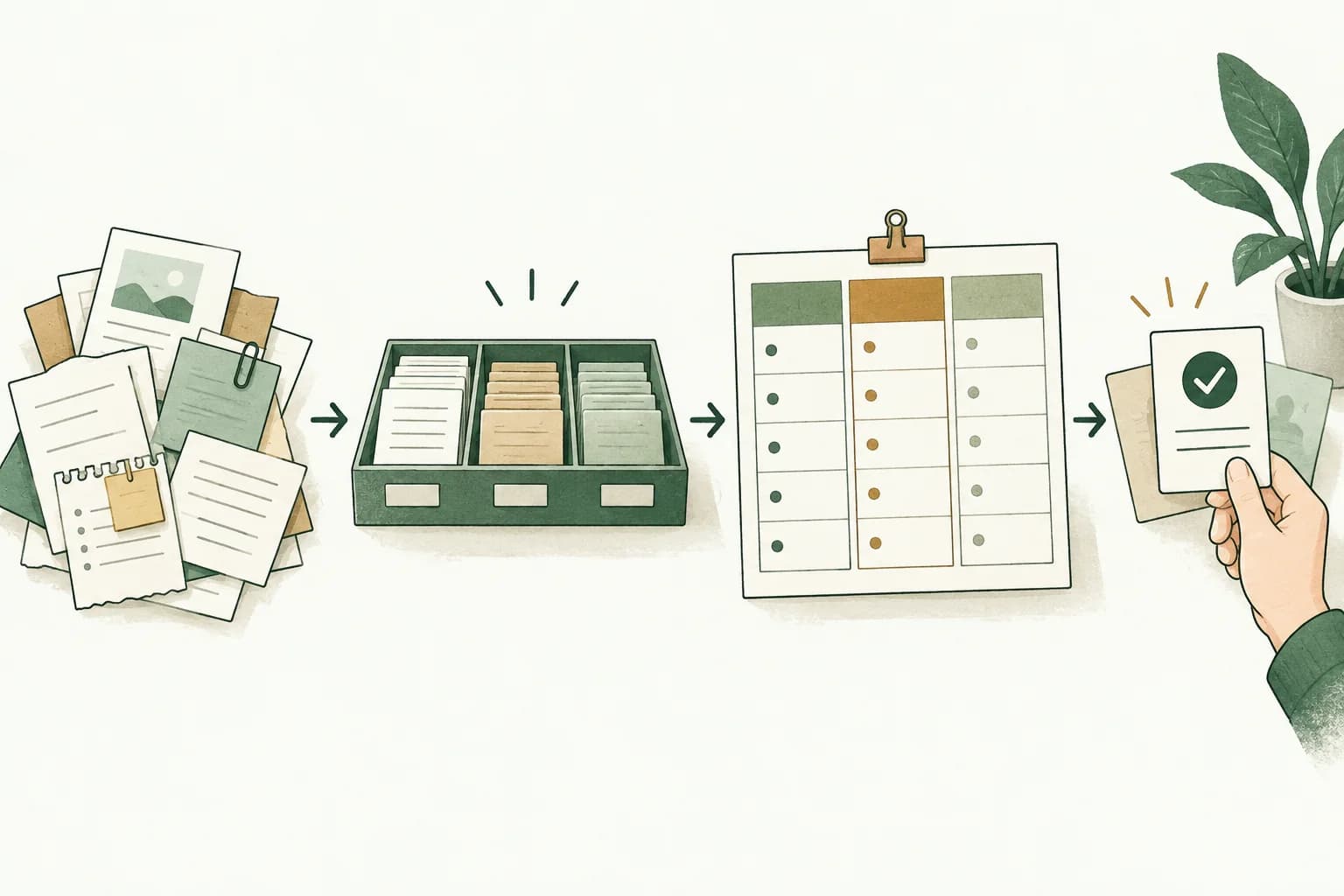
THE STARTING POINT
For a founder who builds and supports an AI SaaS alone, the first thing to automate is not reply generation but an intake step that automatically attaches the contract plan, the last operations and the error that fired. What takes the time is not writing the reply; it is the round trip before a diagnosis can start.
Attach the context that starts a diagnosis before you automate the reply

A&A perspective
If you build an AI SaaS alone and answer its support yourself, the first thing to automate is not reply generation. It is an intake step that attaches the contract plan, the last operations and the error that fired, at the moment the message arrives. Writing the reply is short once you know the cause. What is long is the stretch between receiving the line “it doesn't work” and knowing where to look. Until you close that stretch, automating the answer text does not change when a human can actually begin diagnosing.
A&A perspective
Discussion of AI-received support usually turns into a discussion of how many messages were answered automatically. But in a one-person operation the hours actually disappear before the diagnosis, in the question-and-answer round trip: “which plan are you on?”, “what screen were you on and what did you press just before?” Two exchanges like that can consume half a day to a day, and the inquiry stays unresolved throughout. That duration is an illustrative figure, not something A&A measured. So the first thing to design is the information attached at intake, not the reply.
A&A perspective
This article uses two overseas primary sources. One is the automation platform Gumloop's published account of its own support operation, which states what it attaches at the moment a ticket opens. The other is an Anthropic engineering article on what a tool should return so that a decision can actually follow. Both are the publisher's description of its own work, not an independent audit. Source statements, A&A's reading and a fictional worked example are kept separate throughout.
Gumloop's account: attach the user's situation at the moment the ticket opens
From the sources
Gumloop published how it built its own support operation on its own product on February 17, 2026; the author is Max Brodeur-Urbas of the company. The article states explicitly that the support team has two people (“our support team has only two people”). It then places the work of gathering the user's situation in its own section, which opens by saying that “to address the customer's concerns, a support agent needs to understand the customer's context”, and immediately lists three questions: “Who is this user? What plan are they on? What have they been doing in the product?”
From the sources
The timing of the attachment is before a human reads anything. The article states that “every time a support ticket opens, a workflow automatically queries internal databases and pushes a complete user dossier directly into Pylon”. What gets attached is “the most up-to-date info on the user's profile, activity history, and error counts”, and the article notes that “this data is synced every 30 minutes”.
From the sources
The purpose is stated in the article too. Near the end, after noting that the operation did not start out fully formed but “grew one workflow at a time, over months of continuous iteration”, it lists three lessons learned. The second is “Context is king : when it comes to support, speed matters.” It goes on to say that the user intelligence system “automatically assembles a complete customer profile and pushes it into every ticket before a human even reads it”, with the result that “the support agent never has to waste the user’s time asking questions like ‘what plan are you on?’ or tabbing between dashboards.”
From the sources
A second path runs the other way, from the error to the user. When an error is detected a message goes to an error-monitoring Slack channel, which triggers a workflow that “automatically extracts the user ID from the error message, identifies the user, and provides context on the user's recent activity”. Another agent runs every 30 minutes to find “the specific users with the most errors and anomalies”, which the article says lets the team “proactively identify bugs and reach out, before a user even files a ticket”.
A&A perspective
What the source puts in front is speed. A&A's reading, which the source does not state, is that what produces the speed here is not a shorter reply-writing step but the fact that not one round trip has to happen. Three things are worth extracting. The context assembly sits before a human reads the ticket. The attached fields are named specifically — profile, activity history, error counts — rather than left open-ended. And the path from an error back to a user reuses the same information. Note, though, that a 30-minute sync also means an attached value can be up to 30 minutes old. The source does not present that staleness as a problem; but anyone choosing their own fields has to decide first whether a stale value for that field would mislead a decision. That reading is A&A's, not the source's.
A&A perspective
At the same time, carrying this case straight into a one-person company does not work. The subject is a two-person team at an automation platform company, with internal databases, BigQuery and Pylon already in place. A solo developer has their own database and error logs in whatever shape they happen to be. So what transfers is not the machinery but the ordering: before a human reads the ticket, a small number of specifically named fields are already on it.
| Attached field | The next decision it unblocks | Not attached |
|---|---|---|
| Contract plan and remaining limit | Separate a specified limit from a defect, first | Billing history and payment method detail |
| Last three operations, in human-readable names | Cross-check the user's words against the log and build a reproduction | A list of internal IDs only, and the full operation history |
| Type and count of errors in the same window | Judge whether it is this user alone or a whole-service fault, and set the order | Full stack traces and other users' rows |
| Size and format of the target data | Separate an input-value problem from a processing-side problem | The file itself and the submitted content |
| Which conditional branch the case fell into | Decide whether the fix is code or what is displayed | Production configuration values and credentials |
| Retrieval timestamp of each value | Judge whether an attached value can be trusted | A verdict that hides how stale the value is |
Anthropic on tool design: return the fields that move the next decision, not everything
From the sources
In an engineering article published on September 11, 2025, Anthropic sets out design guidance for the tools handed to agents. On choosing fields, it says implementations “should take care to return only high signal information back to agents”, and that they should “prioritize contextual relevance over flexibility, and eschew low-level technical identifiers (for example: uuid , 256px_image_url , mime_type )”. The stated reason is that fields such as name, image_url and file_type “are much more likely to directly inform agents' downstream actions and responses”.
From the sources
It is equally specific about consolidation. The article writes: “Instead of implementing get_customer_by_id , list_transactions , and list_notes tools, implement a get_customer_context tool which compiles all of a customer's recent & relevant information all at once.” On logs it says: “Instead of implementing a read_logs tool, consider implementing a search_logs tool which only returns relevant log lines and some surrounding context.”
From the sources
On how identifiers are written, the article records the company's own finding: “merely resolving arbitrary alphanumeric UUIDs to more semantically meaningful and interpretable language (or even a 0-indexed ID scheme) significantly improves Claude's precision in retrieval tasks by reducing hallucinations”. The article gives no population, measurement date or method behind that “significantly”. It should be treated as the company's own report and never converted into a number.
From the sources
The article also shows how to control volume. It proposes a response_format enum parameter on a tool so the agent can control whether the tool returns “concise” or “detailed” responses, and notes of its own Slack example that “we use ~⅓ of the tokens with ‘concise’ tool responses”. It adds that for Claude Code “we restrict tool responses to 25,000 tokens by default”.
A&A perspective
What this article is about is what a tool returns to an agent, not what a human support person reads. Applying it to a support intake sheet is A&A's transfer, and the source does not make that claim. The token-efficiency material does not carry across to a sheet a person reads at all. But three things do. Consolidate into one place instead of tabbing between screens. Bound logs to the relevant lines and their surroundings rather than the whole file. And put names a human can read alongside internal identifiers.
A&A perspective
That yields one criterion for choosing fields. Select on whether seeing the value changes what you do next, not on whether the value is available. A field added because it was easy to fetch only makes the intake sheet longer and less likely to be read. Conversely, a field where a single change of value changes where you look next is worth attaching even as one line.
The reproduction sheet: five fields one person can maintain
A&A perspective
What follows is A&A's design. Limit the fields attached automatically at intake to five. First, the contract plan and how much of its limit remains. Second, the last three operations, written in names a human can read. Third, the type and count of errors that fired for this user in the same time window. Fourth, the size and format of the data being acted on. Fifth, which conditional branch in your product this case actually fell into. The count is five because five is what one person can keep correct.
A&A perspective
The phrase “in names a human can read” in the second field is not optional. If the operation history is a column of UUIDs and endpoint names, even the person who wrote the code needs time to reconstruct what the user was doing. Inquiries arrive in the user's vocabulary, so the thing you cross-check against has to be in the user's vocabulary too.
A&A perspective
Keep the error field as “type and count” rather than full text. For a single inquiry, what you need to know is whether this is happening only to this person or has been happening to everyone for the last while. Knowing that binary first sends the rest of the investigation in a completely different direction: if it is happening to everyone, the cleanup comes before the reply.
A&A perspective
Set one pass criterion for the five fields. When you read the intake sheet, is the number of things you still have to ask zero or one? If two or more remain every time, the field selection is wrong. You do not need to measure per-case counts. Listing a week of inquiries and writing one line each on what you had to ask back is enough material to swap a field out. Note that the five fields themselves are not AI-specific — they would fit any stateful SaaS. If you need to handle complaints about the AI output itself, add the model and version, whether a retry or a cut-off occurred, and an identifier for the output the user is objecting to. Use an identifier rather than the output text, so that it stays compatible with the non-attached list in the next section. Swap them in for the least decision-moving of the five rather than adding to the count.
Decide what you will not attach, first
A&A perspective
Left alone, “attach the context” slides into “attach everything, just in case”. So write the non-attached fields in the same place as the five. The contents of the data the user submitted. Attached files. Credentials and tokens. Other users' rows. Put those four on the side you go and fetch deliberately, with a scope and a reason, once the investigation actually needs them. On the intake sheet, whether they exist and how large they are is enough.
A&A perspective
Decide how you handle staleness as well. Put a retrieval timestamp next to each attached value so the gap against the inquiry's arrival time is visible. A value of unknown age is more dangerous than a missing one: a missing value makes you ask, while a stale value gets believed and sets the direction of the investigation. The 30-minute sync described in the Gumloop account carries the same exposure. The source does not present it as a problem.
A&A perspective
Visibility scope belongs in the same table. While you are alone it makes no difference, because you can see everything. The moment you add an outside collaborator or a first hire, the fields needed to begin a diagnosis and the fields that person may see stop being the same set. If the table already exists, splitting it at that point is a line-level edit.
A fictional example: one “I can't save” message reaching diagnosis
Hypothetical example
The following is fictional. It is not a real customer and not an A&A result. Suppose you run a document-summarizing AI SaaS alone. At 10:15 on a Tuesday, a single line arrives: “I can't save.” With no context attached, this is where you start asking. Which plan? Which screen? What were you trying to save? The reply lands in the evening and the diagnosis begins the next day.
Hypothetical example
With the five fields attached, the intake sheet reads like this. Plan: free, with zero remaining processing allowance this month. Last operations: “create summary”, “create summary”, “save”. Errors: two “limit exceeded”, with none for other users in the same window. Target file: a 12-page PDF. Branch taken: “free plan limit handling”. Reading those five lines tells you this is not a defect but a failure to explain the limit.
A&A perspective
What changed in this example is not the wording of the reply but that there is nothing left to ask on the first pass. It also settles where this case goes. If the limit was not explained well enough, the fix is not code but what the product displays as the limit approaches. Designing that branch is handled not here but in “Do not send AI service support straight to the backlog: fix, explain, build”. This article is one step earlier: how to assemble the material that makes the split possible.
When this design does not fit, and how to check
A&A perspective
If most of your inquiries are “how do I get started” usage questions, attaching reproduction context gains little. In that case the waste is not the round trip before diagnosis but the absence of an explanation. And in a product that holds no per-user state, there is nothing to attach in the first place. This article's argument is limited to products whose contract plan and operation history live in their own database.
A&A perspective
The harm from a wrong field is worth stating too. If a stale value, or a value aggregated on a different basis, is attached, the round trip disappears but you begin an investigation in the wrong direction with confidence. When you add a field, write one line for its definition and where it comes from, so you can verify it yourself, and only then attach it. Checking accuracy is a separate exercise from building the attachment.
A&A perspective
The check takes a week. List the inquiries that arrived this week and write one line each on what you had to ask before you could start diagnosing. If the same question appears three or more times, that is your candidate field. If the questions differ every time, this design is a low priority for you. How to decide the conditions for handing a case back to a human mid-flow is handled separately in “Before letting AI receive support inquiries, define the conditions for handing them back: measure wrong resolutions, not just answer rate”. For where this sits in the whole workflow, see “AI-native GTM: a practical guide for solo founders and small teams”.
A&A perspective
Do not convert the removed round trips into revenue or churn improvement. What this design changes directly is the number of exchanges per inquiry and the time until a diagnosis can start. What follows from that depends on your volume, your subject matter, your price and the state of your product. This article does not present an A&A delivery result; it presents published source statements and a design reassembled from them.
Before automating the reply text, attach five fields automatically at the moment a support message arrives — contract plan and remaining limit, the last three operations in human-readable names, the type and count of errors in the same window, the size and format of the target data, and the conditional branch the case fell into — and in the same table write the fields you will not attach and the retrieval timestamp of each value. There is one pass criterion: when you read the intake sheet, is the number of things you still have to ask zero or one? List a week of inquiries, write one line each on what you had to ask before diagnosing, and swap fields on that basis. Only when the same question appears three or more times is this design a high priority for you.
Sources & editorial note
Primary pages read for this article. Publication dates below belong to the sources; access dates record our research.
- Supporting the world's most AI-native companies with a 2-person team
Gumloop · 2026-02-17
Accessed 2026-09-28 - Writing effective tools for agents — with agents
Anthropic · 2025-09-11
Accessed 2026-09-28
AI-assisted editorial production
A&A uses AI for research, writing, translation and editorial checks. Source facts, our analysis and hypothetical examples are labeled separately.
Editorial check: 2026-09-28