A&A INSIGHTS
AI-native service-company cases: what Advolve, Newfront and Lindy help founders compare
For solo and small service founders: compare what customers receive, who operates the work and who checks it, using primary accounts of Advolve, Newfront and Lindy. Turn the distinction into an offer boundary card.
日本語で読む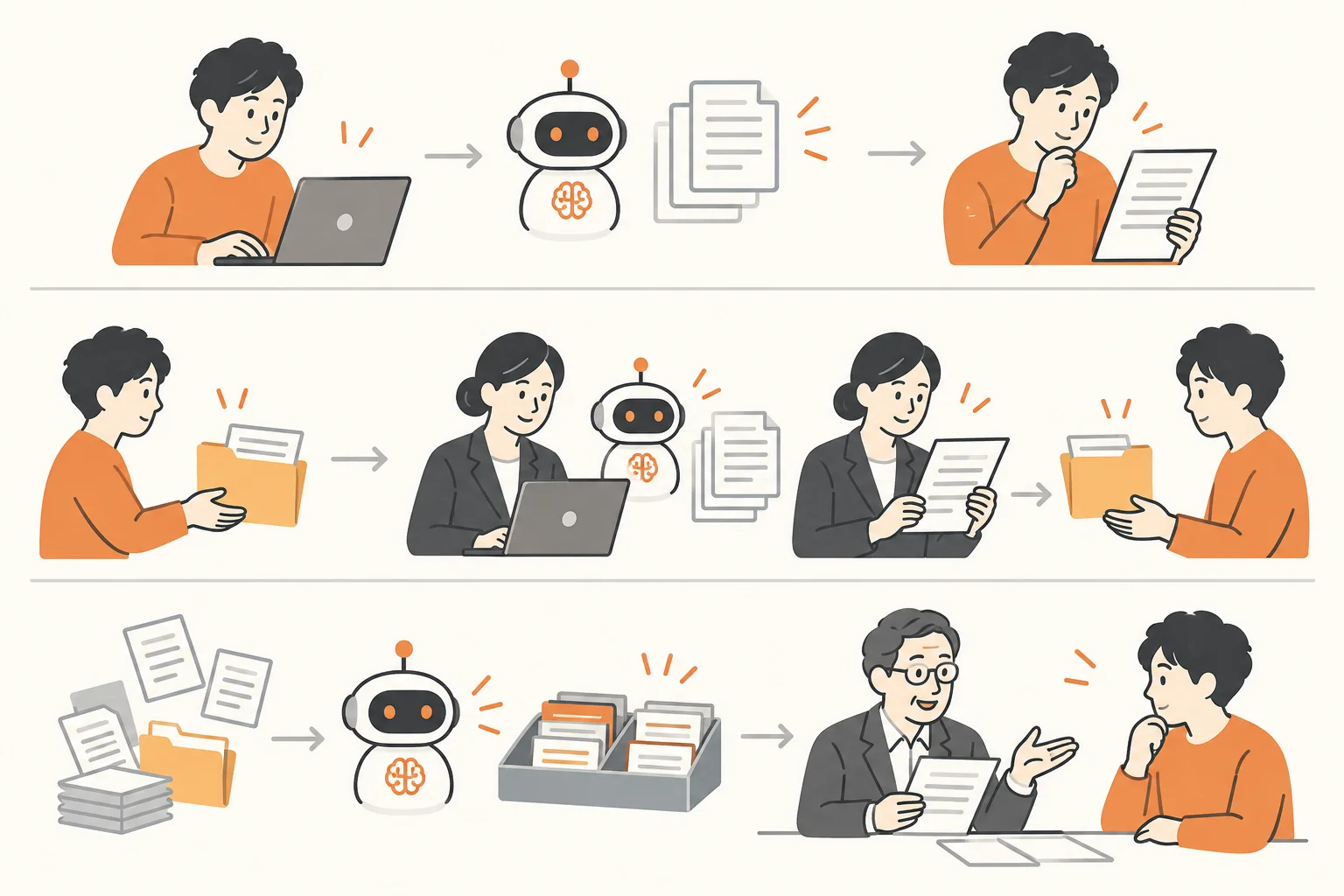
THE STARTING POINT
AI-native service cases become useful when you compare what the customer buys and who operates and checks the work. We read Advolve, Newfront and Lindy as different designs, without classifying them all as outsourced service firms. Source descriptions are separated from A&A analysis, and a fictional creative-studio intake example shows how to specify an offer and its completion criteria.
Is the customer buying a tool or asking you to do the work?
A&A perspective
A founder turning AI-enabled work into an offer needs to decide who will keep operating it, as well as what it can do. Organizing inquiries might mean supplying a tool that the customer operates, or delivering checked intake records every day. Those are different offers. Start by naming the delivered item, the daily operator and the person who checks the result. These three questions guide our reading of AI-native service-company cases.
A&A perspective
We compare public accounts of Advolve, Newfront and Lindy without treating all three as the same kind of outsourced service firm. Their workflow descriptions offer different lenses: delivering work, combining expertise with AI, and providing a platform customers use. Where the accounts do not establish contractual responsibilities, we leave questions to resolve before quoting work.
What the three primary accounts actually describe
From the sources
Anthropic describes Advolve as a B2B Service-as-a-Software and AI-native company, expanding from creating ad assets to cross-platform campaign setup, deployment and optimization.
From the sources
The Newfront account describes AI handling routine work while brokers provide strategic guidance and address complex client problems.
From the sources
The Lindy account presents a platform where businesses create AI agents, with GTM, customer support and executive assistance as use cases.
A&A perspective
The table uses comparison lenses selected by A&A; it is not a classification of each whole company or an audit of pricing and contracts. We do not extend the AI-native self-description to all three. A small team can consider including operation in its offer, preserving expert judgment, or supplying tools through which users delegate work. It cannot turn the companies’ integration scope or reported outcomes into promises of its own.
| Case and lens | Work or product described | Operation and review still unconfirmed |
|---|---|---|
| Advolve: a connected scope of work | Ad assets through cross-platform setup, deployment and optimization | Customer operations, final approver and contractual responsibilities are not established here |
| Newfront: expertise combined with AI | Routine AI processing alongside brokers’ advice and complex client work | Case-specific checks, customer approval and contractual responsibilities are not established here |
| Lindy: users delegating work | A platform for businesses to create agents for GTM, support and assistant tasks | The boundary of user operation and provider support, final review and contractual responsibilities are not established here |
Compare who acts when work stops after delivery
A&A perspective
An incomplete input is often more revealing than a successful demo. A software offer might require customers to gather missing material and rerun a task. If you take on the work, decide whether identifying the gap, asking for clarification and restarting belong inside your service. If expert judgment is the value, identify who reviews the AI-organized material and explains the decision to the client. These are questions for comparing your own offers, not descriptions of the three companies’ contracts.
A&A perspective
Writing “a human” in the review field hides the founder’s workload. Distinguish a qualified person on your team from the customer’s approver, or identify both. Retaining final customer approval does not automatically transfer checking and corrections you promised to the customer. Conversely, taking over every step may be excessive when the customer has the skill and capacity to operate the work. Ask which judgments they want to retain and which tasks they want to hand over.
Hypothetical example: three offers for a creative studio’s intake
Hypothetical example
This is neither a real engagement nor an implementation of the three products. Imagine a small AI-enabled creative firm offering inquiry organization to another studio. Inputs are request messages approved for sharing and intake rules. The output is an intake record containing the request, desired deadline, open questions and a suggested owner. The scope ends at internal intake; it excludes committing to prices or automatically replying to customers.
Hypothetical example
In the tool offer, the customer’s intake person supplies inputs, corrects the output and hands it to colleagues. The provider supports agreed functions and defects but explicitly excludes daily intake operation. In the operated service, the provider checks the record before delivery, holds incomplete items as unresolved and requests clarification from an agreed contact. The customer decides whether to accept the job and at what price. In an expert-assisted offer, a person with production expertise uses the AI-organized material to discuss ambiguous requests and clarify scope with the customer.
Hypothetical example
Acceptance in this example checks whether required fields trace back to the original message, requested deadlines remain requests rather than commitments, and open questions have someone to ask. Test whether a tool’s customer can perform these checks, or whether an operated service actually delivers records with the agreed checks completed. For expert assistance, verify that the discussion leaves unresolved issues and decision owners visible. The same AI output can sit inside different definitions of completion.
Write an offer boundary card before quoting
A&A perspective
Begin a one-page offer card with one sentence: whose task will you move to what completed state? Then list inputs and usage conditions, the delivered item, daily operator, quality reviewer, exception contact, exclusions and evidence of completion. Blank fields become questions for the next customer conversation; do not ask AI to fill them with invented facts. A combined software-and-service offer is also possible, provided the responsibilities included in each part stay visible.
A&A perspective
For an offer that includes provider review, avoid pricing or setting capacity from generation time alone. Include source checks, clarification, corrections, integration failures and tool usage. In an initial trial, compare the existing work needed to make an intake record usable with the proposed process through completed review, using comparable requests. Record where unsuitable inputs were stopped and whose waiting time increased. A growing backlog of unchecked items is evidence for narrowing scope or volume.
A&A perspective
The trial informs whether the current team can deliver the promised work. A single sale, shorter processing time or more outputs does not establish recurring demand or profit. An operated service may be unsuitable if customers want to retain intake control, you cannot supply the necessary expertise, or required material cannot be shared. Keep supplying a tool, offering narrower advice, or declining the work as possible decisions.
Choose the work you own before choosing the system
A&A perspective
The useful takeaway is a way to compare what you sell, not a recipe for reproducing these companies. If you bundle work into a service, can you handle interruptions within that work? If you support an expert, does the evidence enable the judgment they retain? If you provide a tool, can customers keep operating and checking it? The answers change which functions and support you need first.
A&A perspective
For the broader path from acquisition to retention, use the related AI-native GTM guide. Then create your offer card and agree with the customer who checks what. If the offer boundary is still unclear, a conversation can focus on that decision. If it is defined, discussion can move directly to building the necessary integrations and review steps.
Using AI does not define the service boundary. In your next proposal, name the delivered item, daily operator, reviewer and exception contact, then compare them with the work the customer wants to hand over. Confirming that boundary is the starting point for choosing a system and deciding how much work the team can accept.
Sources & editorial note
Primary pages read for this article. Publication dates below belong to the sources; access dates record our research.
- Advolve automates digital marketing with Claude
Anthropic · Publication/update date not stated on the inspected page
Accessed 2026-09-21 - Newfront Claude Platform (API) case study
Anthropic · Publication/update date not stated on the inspected page
Accessed 2026-09-21 - Lindy Claude Platform (API) case study
Anthropic · Publication/update date not stated on the inspected page
Accessed 2026-09-21
AI-assisted editorial production
A&A uses AI for research, writing, translation and editorial checks. Source facts, our analysis and hypothetical examples are labeled separately.
Editorial check: 2026-09-21