A&A INSIGHTS
Before your first overseas customer: currency, minimums, tax registration
For a solo or small service firm: settle a first overseas inquiry from the receiving side — presentment and settlement currency, minimum charge, tax registration.
日本語で読む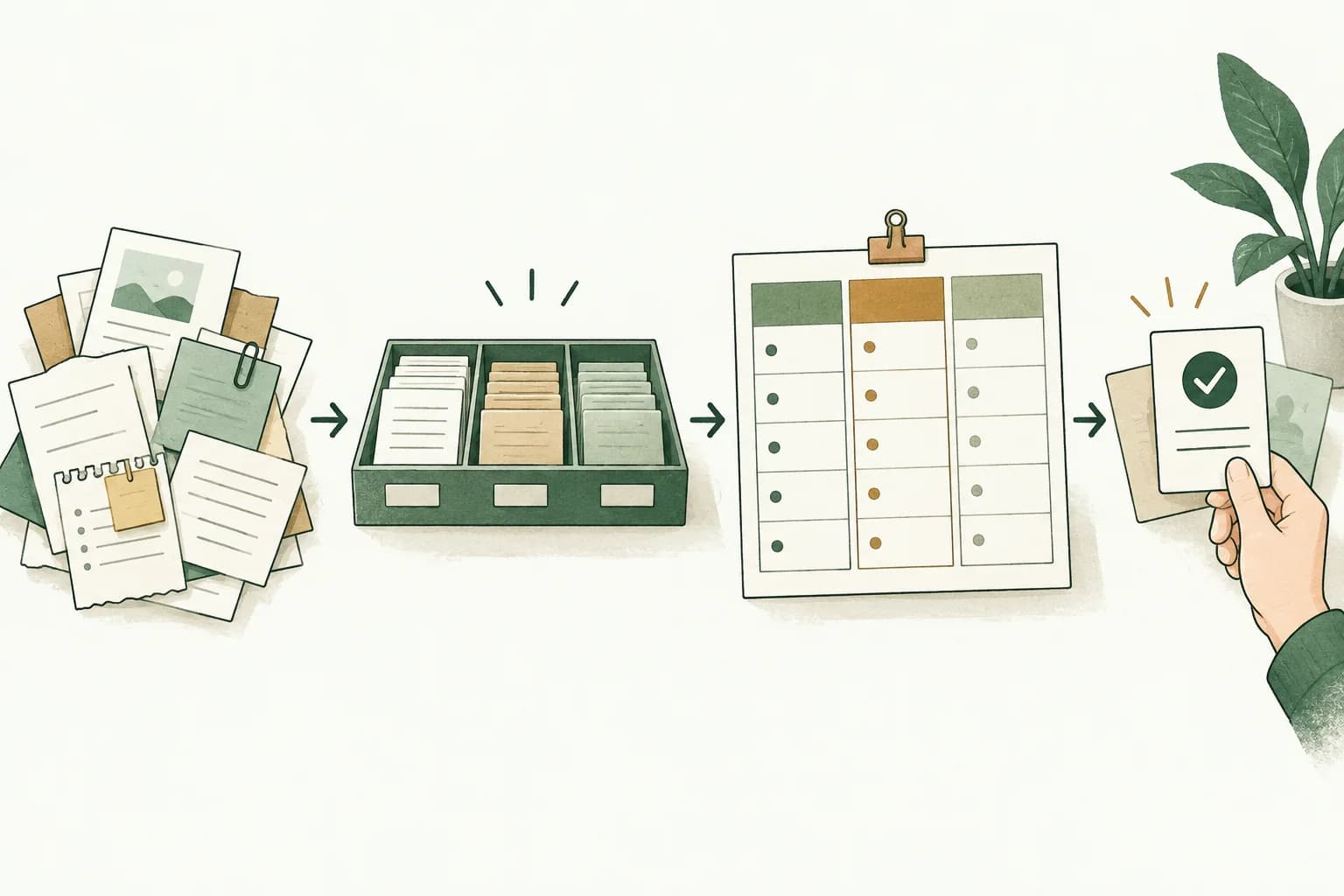
THE STARTING POINT
Whether to accept your first overseas customer is settled not by the size of the opportunity but by whether you can write four lines before you reply: presentment currency, settlement currency, the invoicing unit and its minimum charge amount, and the record that registration will later be assessed from. If all four are written you can accept; if one is blank, that line is both your reason to decline and the condition you can offer the buyer.
Accepting is not a revenue judgement. It is whether you can write four lines
A&A perspective
Whether to accept your first overseas customer is not decided by their budget or by a view on exchange rates. It is decided by whether you can fill in four lines before you write the reply. First, the currency that appears on the quote and the invoice — the presentment currency. Second, the currency that finally arrives in your own account — the settlement currency. Third, whether you will invoice per item at all — and if you will, whether that per-item price clears the payment processor’s minimum charge amount in your settlement currency. Fourth, whether this transaction will be counted towards a tax registration obligation somewhere later, and whether you are capturing today the record that makes that countable. If all four lines are written, you can accept. If one is blank, that line is your reason not to. That is this article’s answer.
A&A perspective
The reason for this order is that the rework in cross-border engagements does not sit on the selling side; it sits on the receiving side. Writing a proposal in English and scheduling a call across time zones are both things one person can now do. What one person cannot do is rebuild the currency and the tax jurisdiction of a transaction already accepted. The presentment currency is fixed the moment you issue the invoice, the settlement currency follows from how your accounts are set up, and whether a tax registration obligation exists is assessed by looking back at transactions that have already happened. Only the irreversible decisions are concentrated on the receiving side. What follows works through where each of those four lines is actually decided, using a payment processor’s own published specifications as primary evidence. Those specifications belong to a payments company and are not tax advice, so read the registration and filing parts on the assumption that a professional confirms the actual position.
There is not one currency: payment method, presentment, settlement
From the sources
Stripe’s published currencies page states that currency affects three aspects of a payment. The first is the customer’s own instrument: "The customer’s payment method currency, such as their credit card or bank account". The second is the charge itself: "The currency of the charge, called the presentment currency". The third is where the money lands: "The currency accepted by your destination bank account or debit card, called the settlement currency". The page adds that when the charge currency differs from the customer’s payment method currency, the customer may be charged a foreign exchange fee by their own bank: "If the charge currency differs from the customer’s payment method currency, their bank or card issuer might charge the customer a foreign exchange fee."
From the sources
The same page states that when the charge currency differs from your settlement currency, Stripe converts the charge into your settlement currency, and that "You can charge customers in over 135 currencies and receive funds in your preferred currency." It also describes that in certain countries settlement in additional currencies may be supported, and that if you need liquidity in additional currencies you enable settlement in them and add a bank account in your payout settings. One caveat about this source: the page includes region-dependent content, and the copy retrieved while writing this article contained a paragraph about accepted card types specific to the viewing region. The three-currency distinction and the conversion explanation quoted above are part of the specification text, not that region-specific paragraph.
A&A perspective
The practical point is that when you write a single currency symbol on a quote, you are in fact settling three currencies at once. Which instrument the buyer pays with is the buyer’s decision. The two you control are the presentment currency and the settlement currency, and if those two differ a conversion sits between them, while if the presentment currency differs from the buyer’s instrument a fee lands on the buyer’s side. "I quoted in dollars and less arrived than I expected" and "the buyer came back asking for a discount" are usually explained by one of those two gaps. The same page also notes that a buyer’s bank may charge them anyway: "The bank or card issuer might also charge the customer if the payment method and your business are in different countries, regardless of the currency used." Aligning the currency therefore does not guarantee the buyer absorbs nothing. What you decide on a first overseas engagement is which gap you absorb and which the buyer absorbs. You cannot write down a forecast of the exchange rate, but you can write down that allocation.
| Line to decide | What you write in advance (worked example) | What happens if you accept without it |
|---|---|---|
| Presentment currency (the currency on the quote and invoice) | Quote English-speaking buyers in US dollars. Quote in Japanese yen only when the buyer is a Japanese entity or pays from a Japanese account | The buyer’s bank or card issuer may charge them a foreign exchange fee, which comes back to you as a request for a discount |
| Settlement currency (what lands in your account) | Settle into a single Japanese yen account. Do not add a foreign currency account | A conversion sits between the quote and the deposit, and you cannot explain why the amount received differs from the amount quoted |
| Invoicing unit and its minimum charge amount (floor tested in the settlement currency) | Do not price per item. Bundle a month’s items into one invoice | Per-item charges fall under the settlement-currency floor and fail, leaving manual collection work behind |
| Record of where the work was taxed (used for future registration) | For every engagement, record the buyer’s country, whether they are a business or an individual, and the type of service supplied, at the time you accept | You cannot assess later whether registration is required, and you reconstruct past transactions from invoices after the fact |
| Decline conditions (the same four lines, inverted) | Say in the first reply that you will not issue a quote until whichever of the four lines is blank has been filled | Work starts with the conditions undecided, and the negotiation about them happens at invoicing time |
The minimum is tested in the currency you receive — and it only bites on per-item pricing
From the sources
The same page sets out a minimum charge amount. The stated reason is that the fee must not exceed the charge: "Stripe enforces a minimum payment amount for all charges to make sure the Stripe fee doesn’t exceed your charge." On which currency determines that floor, the page says "The minimum amount you can charge depends on the payout bank account settlement currency". For charges that need converting it adds "Charges requiring conversion into your account’s default settlement currency must meet the equivalent minimum of the settlement currency." The list on the copy retrieved for this article included 0.50 USD, 0.50 EUR, 0.30 GBP and 50 JPY, among others. That list can change over time. Note also that the page explicitly marks the presentment-currency list as country-dependent ("Stripe users in the selected country can process charges in the following list of currencies") while carrying no such note on the minimums. Build on the structure — the floor follows the settlement currency — rather than on the figures.
From the sources
The same page also states that the unit in which amounts are sent to the API differs by currency. For two-decimal currencies, "1000 to charge 10 USD (or any other two-decimal currency)." For zero-decimal currencies, "10 to charge 10 JPY (or any other zero-decimal currency)." Japanese yen is listed as a zero-decimal currency, and the page states that to charge 500 JPY you provide an amount value of 500. The same literal 1000 therefore means ten dollars if the presentment currency is USD and one thousand yen if it is JPY.
A&A perspective
Both of these need their scope stated honestly. The floor itself, on the figures above, sits at 0.50 USD or 50 JPY — negligible against any realistic monthly fee or day rate. Monthly maintenance and one-off fixes will essentially never hit it. The floor bites in exactly one design: when you price per outcome or per item processed. Put a per-item price under 50 JPY on each document handled and the charge will not clear the settlement-currency floor at all. And because the test is applied in the settlement currency, you cannot check it by asking what the amount looks like in the buyer’s currency. The minor-unit rule is narrower still: the page is describing amounts sent to the API. If and only if you create charges through code, carrying a yen-shaped intuition into a two-decimal currency puts the amount out by two decimal places. It does not arise while you are issuing invoices by hand.
Hypothetical example
As a worked example, imagine a hypothetical small AI service firm asked by an English-speaking buyer to process documents at a per-item price. This is neither a real customer nor our own track record; it is there to show the shape of the decision. Quoted in US dollars, settled into a single Japanese yen account. Two things get decided. First, check whether the per-item price clears the floor once converted into the settlement currency; if it does not, do not adopt per-item invoicing at all. The alternatives are invoicing the month’s items together, or setting a minimum monthly fee. Second, write the bundling unit — all items in a month, or every N items — into a line of the contract. The floor itself is a trivial amount, but settle none of this and charges that did not clear it leave manual collection work attached to every engagement. The cost is the manual work, not the size of the floor.
The market you can receive from comes first; the country count is the by-product
From the sources
In an article dated May 28, 2026, Stripe analysed solo founders — people who launched a startup through Stripe Atlas without any cofounders. The population, as the article describes it, is that "we analyzed thousands of solo-founded Atlas startups incorporated in 2022 and 2023, each with at least two years of revenue data", comparing middle-decile with top-decile founders by total revenue in their first two years. On countries sold into, the article reports "In the first month, top-decile solo founders sold into an average of 10 countries, versus just three for median solo founders."
From the sources
On revenue mix the same article states "International sales accounted for 51% of revenue for top-decile solo founders, compared with 2% for median solo founders." It then explains much of that revenue-share difference itself: "Much of that difference came down to where founders were based: top-decile solo founders were slightly more likely to be located outside the US, so many sold into the US early." It continues, "Since the US is often the largest and highest-spending market for software, selling there early can accelerate growth." The same page also describes what Atlas supplies: "With Stripe Atlas, solo founders can set up a company, open a bank account, accept payments, and fundraise within two business days from anywhere in the world."
A&A perspective
What transfers from this population to a founder in Japan is not the number of countries sold into but the question of which market you are already in a position to receive from. You cannot execute market entry plans for ten markets in the month after incorporating. What you can have ready inside a month is a receiving path that does not stop a payment from anywhere. So the question this article works on is not "how many countries do we sell into" but "which markets are we set up to receive from", with the country count a by-product that may or may not grow. The reason the source gives for entering early is market size — a sell-side reason — but whether you can sell into that market is not even a question until you can receive from it. The separate, market-side question of which market to sell into first is outside this article’s scope; our published piece "Home market only, or sell abroad? Payments, time zones, accountability" handles it as three distinct loads. This article picks up afterwards, when an inquiry has actually arrived and the receiving conditions have to be filled in.
A&A perspective
Two limits attach to that reading. First, what the source explains by founder location is the international-revenue-share difference, not the country-count difference; for the country-count gap it offers no explanation at all. Second, and more seriously, this population’s "ability to receive" included a US corporation and a US bank account obtained through Atlas — the same page lists exactly that among what Atlas provides, as quoted above. A service firm operating from Japan as an individual or a Japanese company does not have that receiving path. The month-one country figure therefore cannot be explained by receiving-side configuration alone. Beyond that, Stripe’s figures are correlational observations rather than a test of causation, and the article does not claim that selling into more countries produced the revenue. The article is itself written by an Atlas product-side author analysing Atlas customer data, so it is not independently verified.
Registration is assessed later — what decides it is the record you keep now
From the sources
Stripe’s published Tax page describes the obligation-monitoring step as "Identify where you might need to register to collect tax based on past transactions." On threshold monitoring it states "Tracks your sales against local tax registration thresholds and alerts you when you might have tax obligations, helping you stay compliant as your business grows." Both are written in the same order: identify where registration might become necessary from past transactions, and track sales against each jurisdiction’s threshold.
From the sources
On calculation, the same page states "Calculate sales tax, VAT, and GST for transactions worldwide, determining tax rates based on product type", with customer location and business location alongside product type as the inputs that determine the rate. The page also treats country coverage as varying, pointing separately to the list of supported countries and to how calculation and collection work in each region.
A&A perspective
What matters here is not the existence of a feature but the ordering. Stripe describes its own monitoring as working from past transactions. Whether that matches any particular jurisdiction’s registration rule is not something this article can settle. What it does settle is one thing: the record you will need is per-engagement and retrospective. In service work the number of engagements is small, so for a while nothing happens at all. That is precisely why the question is whether you capture, at the first engagement, the record that makes it countable later. Three fields per engagement are enough: the buyer’s country, whether the buyer is a business or an individual, and the type of service supplied. Keep those from the moment you accept and nothing has to be reconstructed when some threshold eventually comes into view. Skip them and you will be re-deriving buyer locations from invoices and bank records. All of the above is a payments company describing its own product, not tax advice. Your actual registration and filing obligations as a Japanese business are set by the legal systems of your country and your customer’s country. This article takes no position on them and treats them as items to confirm with a professional.
The four-line acceptance sheet you fill in before replying
A&A perspective
Collected onto one page, the above becomes the table below. Alongside the four lines there is a fifth, the decline conditions, which are simply the four inverted. It is not a price list and not a contract template; it is a working sheet you fill in for yourself before writing the reply. How long it takes depends on your situation, but it is not repeated per engagement. Once it exists, you answer the next overseas inquiry from a decided position rather than deciding from scratch.
Hypothetical example
The entries in the table are hypothetical, written for an imagined small AI service firm. They are not a real customer’s terms, not terms we operate under, and not currencies or prices recommended to the reader. In your business the policy on presentment currency and the shape of your settlement accounts will come out differently. What is worth copying is the format, not the content: a line only becomes a decision once all three columns are filled — the line to decide, what you write in advance, and what happens if you accept without it. A row whose third column you cannot write is a row you have not actually decided.
Decline in the same four lines you would have accepted in
A&A perspective
Most of the delay in replying to an overseas inquiry comes from not having the words to decline. "We will pass on this one" tells the buyer nothing and leaves you with nothing to decide from next time. Using the four lines turns a refusal into a statement of conditions. "We can quote in US dollars, but we settle into a single yen account and we absorb the conversion. At the per-item price you have asked for, each charge falls below the processor’s minimum in our settlement currency. We can take this if you are willing to be invoiced for a month’s items at a time" is a refusal and simultaneously a condition under which the work happens. Replying in that form means that later you can count which declined inquiries would have closed on a condition.
Hypothetical example
Operationally, one line per declined inquiry is enough. Three fields: the buyer’s country, which of the four lines caused the decline, and whether the buyer accepted the condition. Cut it by count rather than by time: once five overseas inquiries have accumulated, look only at whether the same line keeps being the reason. If it does, reconsider how that line is set. If the invoicing shape keeps being the cause, the choice is between writing down that you do not take per-item invoicing and changing the unit you bundle into. This is a hypothetical operating example, not our own record. There is no measured basis for five; it is simply the smallest batch that lets you look at inquiries that actually arrived rather than at estimates.
What this article does not decide, and the next step
A&A perspective
This article takes no tax position. Everything quoted is a payments company publishing specifications about its own product; none of it is law or tax advice. Actual registration and filing obligations are set by the legal systems of the supplier’s country and the customer’s country. No specific currency, price or country is recommended. Stripe’s solo-founder figures are correlational observations over a population that incorporated US companies, not targets for a Japanese service business. We present no overseas customer acquisition record or results of our own. The specification pages show no update date and contain region-dependent sections, so open each page yourself and check its current wording when you actually fix your conditions.
A&A perspective
The next step is to fill the four lines in your own words and to carry them through to the decline conditions. If you then accept a first overseas engagement, start the one practice of recording the buyer’s country and the type of service supplied at the moment you accept. How to count a repeat is handled in our published piece "Before scaling acquisition: how to count a customer as returned". If you want the whole flow first, "AI-native GTM: a practical guide for solo founders and small teams" is the map. Deciding which of the four gaps you absorb and which the buyer absorbs is the kind of question that can be worked through at the advisory stage if you cannot settle it alone.
Whether to accept a first overseas customer comes down to writing four lines before you reply: presentment currency, settlement currency, minimum charge amount, and the record that tax jurisdiction will later be counted from. Presentment and settlement are separate decisions, and where a gap exists it surfaces as either a conversion on your side or a fee on the buyer’s. The minimum charge is tested in the currency you receive rather than the one you quoted, but at 0.50 USD or 50 JPY it only bites if you decide to price per item. Whether registration is required is assessed by looking back at transactions already accepted rather than at countries you plan to enter, so capture the buyer’s country and the type of service from the very first engagement. The specifications quoted belong to a payments company and are not tax advice, and Stripe’s figures are correlational observations over a population of US-incorporated companies. If one of the four lines is blank, that line is your reason to decline — and the condition you can offer the buyer.
Sources & editorial note
Primary pages read for this article. Publication dates below belong to the sources; access dates record our research.
- Solo founding is at an all-time high: Top performers have these traits in common
Stripe · May 28, 2026 (date shown on page)
Accessed 2026-10-07 - Supported currencies | Stripe Documentation
Stripe · no publication or update date shown on page
Accessed 2026-10-07 - Stripe Tax | Stripe Documentation
Stripe · no publication or update date shown on page
Accessed 2026-10-07
AI-assisted editorial production
A&A uses AI for research, writing, translation and editorial checks. Source facts, our analysis and hypothetical examples are labeled separately.
Editorial check: 2026-10-07