From AI meeting notes to next tasks: 4 decisions before you pick a tool
AI meeting notes stall work because no one decided what to record or where tasks go, not because summaries are weak.
Key points
- Pick meetings to record before any tool
- AI drafts tasks, people check, then send
- Fixed steps send tasks where owners look
- Measure the days to reach the owner

Contents
Decide which meetings to record before you pick a tool

A&A perspective
AI meeting notes are tools that record a meeting, turn it into text, and automatically produce a summary and even a list of candidate next tasks.
A&A perspective
When a handful of employees and contractors run the company, the owner often sits in both the client check-ins and the calls with outside vendors. The recordings and summaries are all there, yet the following week the same points get explained again out loud. When work stalls like this, a poor summary is not always the reason.
A&A perspective
Before you start, the first thing to decide is which meetings to record. Comparing products can wait until you have settled four things: the scope of what you record and where tasks go, plus the point where a person checks and how you measure the effect.
From the sources
Otter is a company that offers an AI service that records and summarizes meetings automatically. According to Anthropic's customer story on Otter, Otter weighed performance, cost and security, and then switched from another company's AI model to Claude.
From the sources
The story names the ability to handle long meeting transcripts in one pass as the deciding factor. It also mentions that Anthropic agreed to Otter's requirement not to retain meeting data, and that the pricing made a company-wide rollout possible.
From the sources
Otter's director of product management says the value lies in everyone using the same meeting note taker, whichever video meeting platform they use. He describes this as essential for handoffs between teams.
A&A perspective
Automate & Augment (A&A), which writes this article, is a company that redesigns a business's work around AI and takes it all the way through implementation.
A&A perspective
What A&A notices is that none of these reasons or values are about how well the summaries read. Each one is a condition on how much of your record you can gather in one place.
A&A perspective
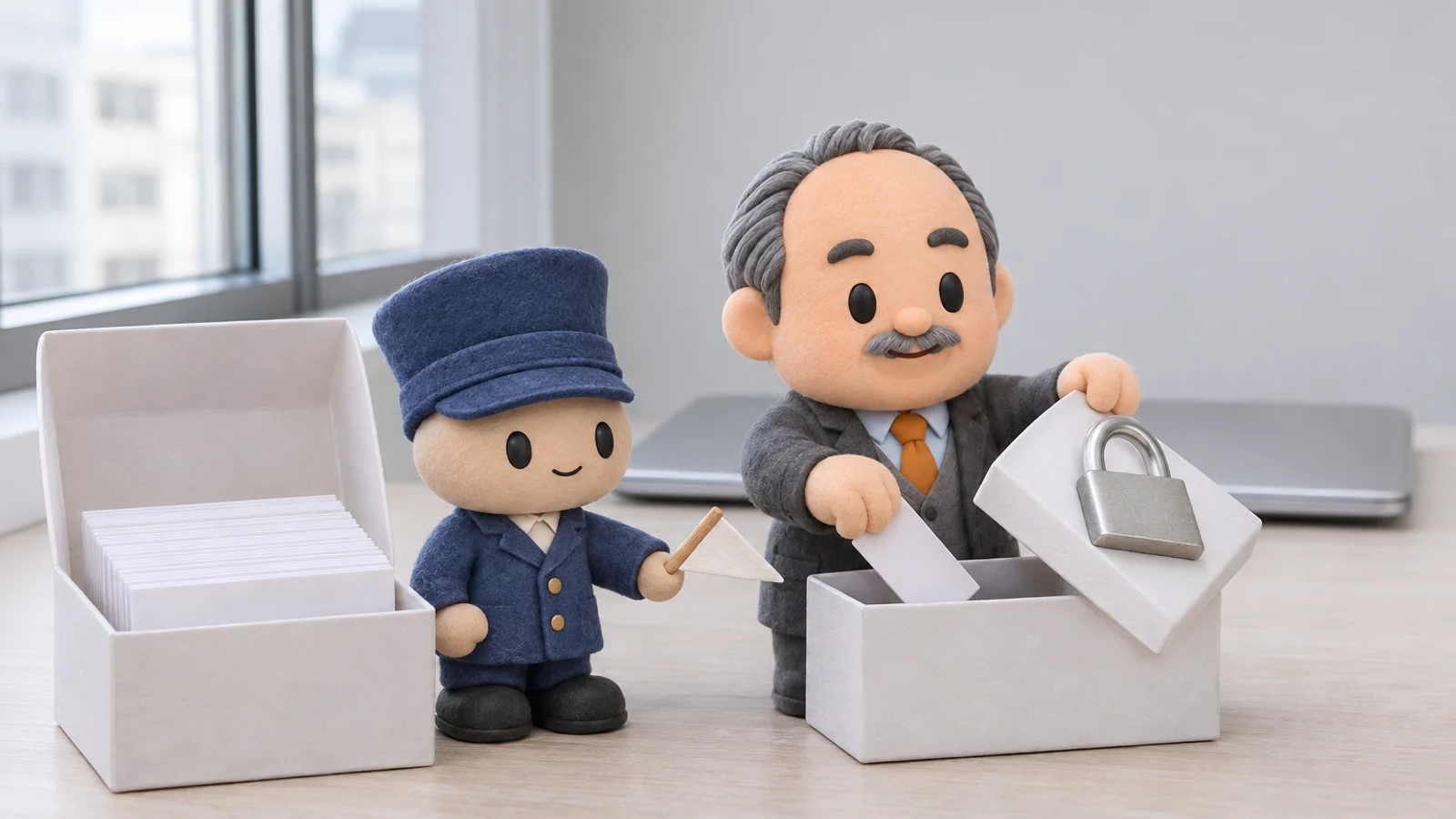
A&A thinks a small company should decide in the same order. Client check-ins, internal project meetings and calls with contractors go into the shared record. HR, pay and legal discussions go in a separate place that only a few people can read.
A&A perspective
Putting more meetings into the shared record is not the goal in itself. Once a topic that should stay restricted, such as an HR discussion, gets mixed into the shared record, you can no longer show that record to everyone. Then you need separate meetings just to pass the other topics on by word of mouth.
A&A perspective
If you record, decide along with the scope whom you tell and ask for consent, where the record lives, and after how many months it is deleted.
AI drafts the tasks; a person checks owner and due date

A&A perspective
AI's job ends at pulling candidate tasks out of the record. Who does what by when is something the person who called the meeting checks before passing it on.
From the sources
In the Otter story, the director of product management says that letting AI summarize meetings and identify the actions removes the legwork of chasing people afterwards. You no longer need another meeting just to recap the last one, he explains.
A&A perspective
But a candidate task appearing is not the same as someone taking the work on. In a meeting, a remark like "I'll look at that by next week" goes by without anyone being sure who said it. Even if AI picks it up as a task, A&A thinks it is hard to decide whether it goes to a contractor or stays in-house without knowing what is happening outside the meeting.
A&A perspective
So A&A splits what comes out of the record into three: what was decided, what is still open, and tasks with an owner and due date. Only the third is reviewed right after the meeting by the person who called it, who confirms the owner and due date before sending.
A&A perspective
In a company where the owner attends every meeting, this check becomes the owner's job. Only two things get checked, though: owner and due date, with no need to reread the whole summary. It stays with a person because deciding whether to hand work to a contractor or keep it in-house is itself a management decision.
A&A perspective
Items that are still open stay open instead of being mixed in with decisions. AI summaries tidy up the conversation, so a point people were still unsure about can read like a decision. It is enough to keep open items as the first topics for the next meeting.
Send tasks by fixed steps to where owners already look

A&A perspective
Checked tasks go one at a time to the place the owner looks at every day. The delivery runs on fixed steps rather than having AI work it out each time.
From the sources
Otter analyzes sales calls against set frameworks and sends the results straight into the customer relationship management system (CRM). The story explains that this keeps the sales team aligned without manual note-taking.
From the sources
Anthropic's design article for developers, "Building effective agents" (December 2024), divides systems that use AI into two kinds: systems that follow steps written in code ahead of time (workflows), and systems in which the AI decides its own steps and how to use its tools (agents).
From the sources
The design article says that for well-defined tasks, workflows are more predictable and behave the same way every time. It also recommends starting with the simplest approach and adding complexity only when needed.
From the sources
The article itself notes, however, that much of the developer tooling it describes has changed since it was published.
A&A perspective
All this article borrows is that split into two kinds. The tools have changed, but A&A thinks the split still holds.
A&A perspective
Passing tasks to a set place is a well-defined task, which suits a workflow. If the destination changes from day to day, owners cannot tell where their tasks will show up.

A&A perspective
The sending process can be built just by fixing the destination channel in the integration between your note-taking service and a chat tool such as Slack, or by writing a short script.
Hypothetical example
From here on is a hypothetical example, not a real company or project. A web design company run by four employees and three contractors is asked in a client check-in to move the launch date ten days earlier. The summary records "Wants to bring the launch date forward." If no one has decided where tasks go, the contract designer first hears about it at the following week's meeting.
Hypothetical example
If the destination is set, the AI suggests a task: "Check the design schedule." The owner confirms that the designer is the owner and the due date is the day after tomorrow, and only that one task arrives in the chat the designer normally uses.
Hypothetical example
What gets sent is not the whole summary but one task and a link back to the original remark. The designer does not have to read the summary.
A&A perspective
Dropping summaries into a shared folder nobody opens does not count as deciding where tasks go. With contractors, ask up front where they normally look.
Measure the days it takes a request to reach its owner

A&A perspective
Whether the setup worked is checked not by summary quality but by the number of days it takes a request raised in a meeting to reach its owner. The other thing to watch is how many times the same explanation had to be repeated. Decide what you will measure before you bring in the tool, too. Without numbers from before, you cannot compare before and after.
A&A perspective
Spending less time on minutes does not turn into profit on its own. Did the work you took on with the freed-up time move forward? Did contractor rework go down? Only when you look that far can you say it helped the business.
A&A perspective
Measuring by hand is enough. For the two weeks before the setup, pick a few requests raised in meetings and write down the day each owner started on them. Do the same for the two weeks after, and you can compare before and after. Even with only a few cases, seeing how many days requests took to arrive shows you what to fix next.
A&A perspective
There are cases where this does not apply. In a company where everyone checks the same task list of to-dos and owners every day, building a new delivery process will probably make little difference. If the same points get reopened every week, what is missing is not a record but agreement on what the meeting is meant to decide. In that case, fix how you run the meeting before the recording setup.
From the sources
The Otter story was published by Anthropic and is not an independent verification. Otter is a company that sells a meeting AI product, and it uses AI models it built itself together with Claude.
From the sources
According to the story, Otter announced "last year" that it had used its own model to summarize more than 50 million meetings. The story gives no publication date, so it does not say which year that was.
A&A perspective
A product company that summarizes 50 million meetings is in a different position from a small company running its own meetings. What this article borrows is only the order of judgment: what Otter treated as deciding factors.
A&A perspective
Where does a person check, and where does a fixed route take over? That line is hard to draw without knowing what AI can do today. A&A draws the line between people and AI while testing where AI stands in daily real operations. The same team owns the work from design through implementation, so nothing is passed along second-hand on the way.
Summary
A&A perspective
When AI meeting notes leave work stuck, the problem is usually in the steps after the summary is made.
A&A perspective
Decide which meetings to record before comparing products
A&A perspective
AI suggests tasks; the person who called the meeting checks owner and due date
A&A perspective
Tasks go by fixed steps, one at a time, to where owners already look
A&A perspective
Measure the effect by the days it takes a request to reach its owner and by how often explanations are repeated
When AI meeting notes leave work stuck, the problem is usually in the steps after the summary is made. Decide which meetings to record before comparing products, have a person confirm owner and due date for the tasks AI suggests, and send each one by fixed steps to where its owner already looks. Measure the effect by the days it takes a request to reach its owner and by how often explanations are repeated.
FAQ
Can AI decide the owner and due date too?
Suggesting candidates is the right place for AI to stop. If it finalizes them without knowing things outside the meeting, such as a contractor's availability or internal priorities, tasks reach the wrong people. For routine meetings where the owner is always the same, you can lighten the check once you are used to it.
How should I choose a meeting AI product?
Make this article's four decisions first, then compare products on them: support for your meeting tool, a choice in how records are retained, and sending tasks to your task list or chat. The deciding factors in the Otter story were also handling long records, not retaining data, and a price fit for a company-wide rollout. A&A reads these as conditions separate from summary quality.
Can I record meetings that include clients or contractors?
Before you do, tell them you will record and where the record will be kept, and get their consent. Leave meetings without consent out of scope, and have a person write up and pass on only the tasks. This article does not assess the legal side.
Sources & editorial note
Primary pages read for this article. Publication dates below belong to the sources; access dates record our research.
- Otter transforms meetings into lasting organizational knowledge with Claude
Anthropic · Publication date not stated
Accessed 2026-10-21 - Building effective agents
Anthropic · 2024-12-19
Accessed 2026-10-21