Sort resident messages with AI: decide owners before reply drafts
If you put AI on resident messages, give each type of message an owner before you compare reply drafts.
Key points
- Give each type an owner before drafts
- Routine questions only get AI drafts
- Return unsure messages to people
- Let AI only sort for the first two weeks

Contents
Before comparing drafts, give each type an owner

A&A perspective
Sorting messages means splitting incoming messages by type and deciding in advance who takes each type. Comparing AI reply drafts can wait until after that.
Hypothetical example
As a hypothetical example, take a six-person company that manages rental properties. The owner and an office manager who runs day-to-day operations share the front desk: they receive every email, phone call and chat message first and pass each one on. Repair arrangements go to an outsourced maintenance coordinator, and lease renewals go to one staff member.
Hypothetical example
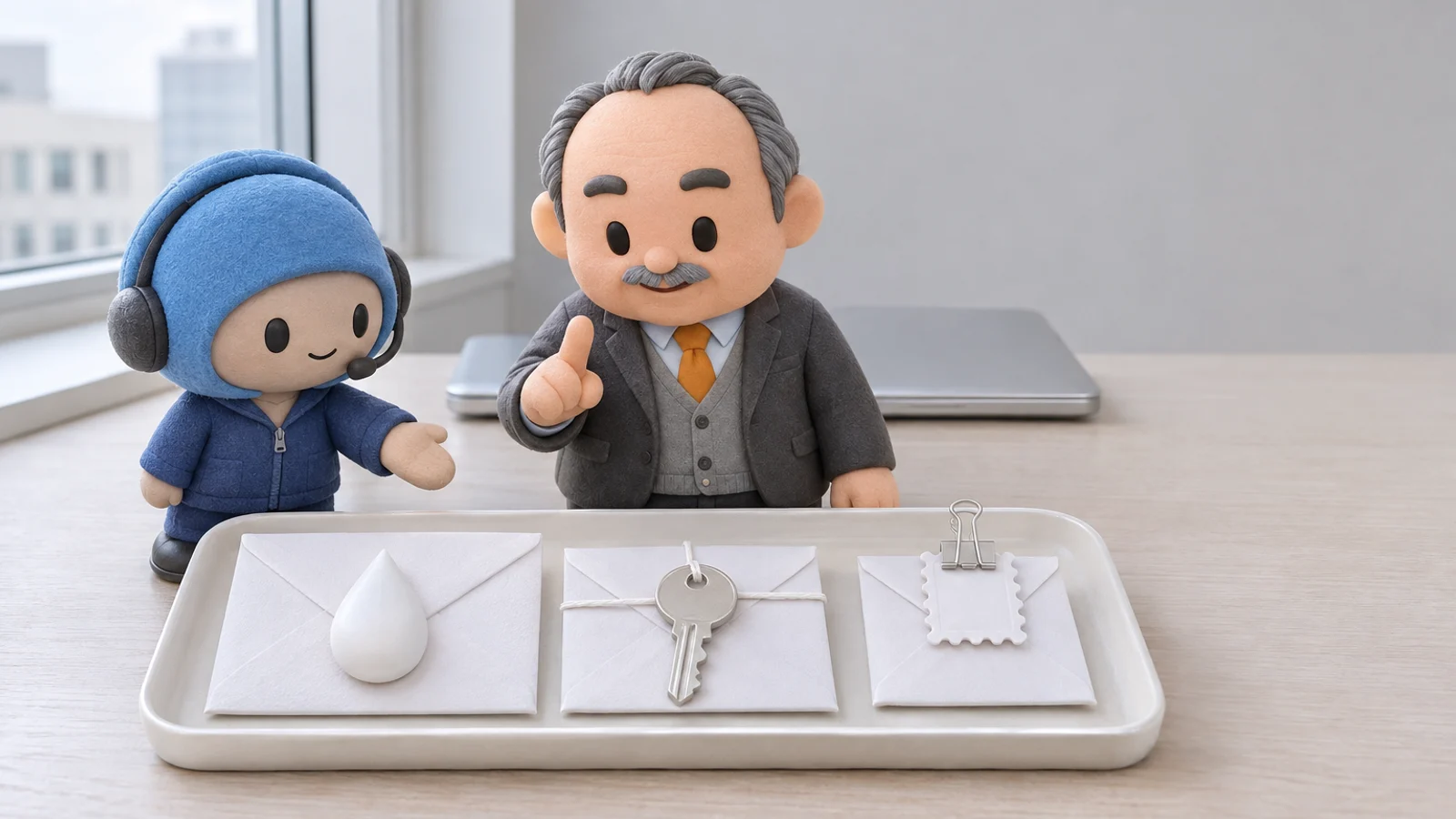
In this company's inbox, a report of a water leak, a question about a renewal date and a repair bill waiting for approval sit in the same queue. However polished the reply drafts are, that queue stays the same. What troubles the owner is not the wording. It is having to decide, every time, which message to deal with first.
From the sources
AppFolio, which provides software for property management companies in North America, uses Claude for communication with residents. According to Anthropic's customer story, its setup uses two models.
From the sources
Claude 3 Haiku handles most general inquiries, where speed comes first. Claude 3.5 Sonnet handles complex communications.
A&A perspective
Both are earlier-generation models. Automate & Augment (A&A), the company writing this article, sees this setup as one that treats messages differently by type before any draft is written. The page does not say how a message is assigned to one model or the other.
A&A perspective
What a small company can copy is not the two-model setup but the order: sort by type first, then reply.
A&A perspective
Once each type has an owner, every message has one destination. A water leak goes to the phones of the owner and the office manager, and a renewal question goes to the staff member in charge. Without owners, drafts from any AI tool pile up in the same inbox.
Hypothetical example
The four types in the table are a hypothetical example. Decide your own split by rereading your own inbox.
Limit AI drafts to routine questions

A&A perspective
The only messages AI should draft replies to are routine questions whose answers are settled in advance. People write the replies on emergencies, repairs, and contracts and costs.
From the sources
AppFolio's customer story says property management communications range from urgent maintenance requests to sensitive policy discussions. It adds that even a simple maintenance request can require checking for duplicate tickets, reviewing maintenance history and coordinating vendor schedules.
A&A perspective
A&A takes from this that, for some messages, the work before the reply weighs more than the wording of the reply. In an emergency, what the resident is waiting for is not a polite answer but someone taking action. If an AI reply arrives first, the resident may take it to mean that help is already arranged.
A&A perspective
Messages about contracts and costs can need the landlord's approval. If AI answers before the approval, the resident is the only one who has the answer. At that point, the staff member in charge and the landlord know nothing yet. Correcting the answer afterwards takes more work than having a person write it in the first place.
A&A perspective
Routine questions are messages whose answers do not change and where a wrong answer is cheap to clean up. Send only these to AI for drafting, and have the person in charge check each draft before it goes out.
A&A perspective
If you compare AI tools that draft replies, comparing their replies to routine questions is enough. However good a tool's draft for an emergency is, it gives you nothing to compare on.
A&A perspective
Draw the line between people and AI not only by what AI can do, but by who has to fix what when it gets something wrong. Even a good draft, used on an emergency, sends the cleanup back to people.
| Type (typical messages) | Owner | AI draft |
|---|---|---|
| Emergency (water leak, power outage, lockout) | Phones of the owner and the office manager | No |
| Repairs in a unit (noisy ventilation fan, torn screen) | Outsourced maintenance coordinator | No |
| Contracts and costs (renewal, move-out, who pays for a repair) | Staff member in charge of renewals | No |
| Routine questions (trash days, open parking spaces, where to send documents) | Office manager | Yes (the office manager checks it before sending) |
Send messages AI is unsure about back to the front desk

A&A perspective
When AI is not confident about how to sort a message, it should not assign a type and should send the message back to the front desk, the owner and the office manager. If the return path is set in advance, a message does not go missing even when AI gets it wrong.
From the sources
"Building effective agents", Anthropic's engineering article on how to build with AI, describes a pattern that classifies an input by type and sends each type to a separate process.
From the sources
One of its examples is customer service: general questions, refund requests and technical support each go to their own process and tools.
From the sources
The article says this pattern works well when there are distinct categories and classification can be handled accurately.
A&A perspective
Some resident messages are too short to classify. Take a single line such as "Water is leaking again." From the text alone, you cannot tell whether it belongs to an ongoing repair or is a new emergency. A&A thinks it is safer to send such messages back to a person than to force them into a type.

A&A perspective
How unsure is unsure enough to send back? Decide by how heavy the cleanup is when the sorting is wrong. Sending an emergency to the normal queue can delay the repair and let the damage spread. Sending a routine question to the emergency queue costs the owner one read. Send emergencies back at the slightest doubt, and hand routine questions to AI only when it is sure.
From the sources
The message text is not the only clue for a reply. AppFolio's customer story says that, for complex communications, the system checks for existing maintenance tickets and takes into account the resident's history and property-specific rules.
A&A perspective
A&A thinks the same records can be used for sorting. If the unit already has an open water-leak ticket, the "again" message can be treated as an ongoing emergency.
For the first two weeks, let AI only sort

A&A perspective
For the first two weeks of the trial, have AI do only the sorting, and do not use drafts yet. What you want to check first is not the quality of replies but whether each message reaches the right owner.
A&A perspective
During this period, record the type AI assigns next to the type the owner and the office manager assign. Look at two things: whether any emergency was missed, where the target is zero, and how closely AI's sorting matches the people's sorting for each type.
Hypothetical example
One table is enough for the record. For example, use five columns: the date and time received, a summary of the message, the type AI assigned, the type a person assigned, and the reason they differ. Reading the reasons for the differences shows whether your split into types fits the actual work. Two weeks is a guide; a company that gets few messages should run the trial a little longer.
A&A perspective
If even one emergency was missed, do not move on to drafts. Fix the split into types or the line for sending messages back to people, and compare again. Throughout the trial, people still read every emergency message.
A&A perspective
Once the sorting matches, start using drafts, for routine questions only. People keep writing the replies on emergencies, repairs, and contracts and costs. This is the stage at which to compare AI drafting tools.
A&A perspective
After you start, reread once a week the places where staff corrected the drafts. That tells you whether you can widen what AI handles.
A&A perspective
A sorting-only prototype, exporting the inbox and having Claude Code assign a type to each message, is sometimes something an owner can build alone. The effort lies beyond that. You need a way to send unsure messages back to the front desk, and a way to save the sorting results in your own records, such as property management software or a spreadsheet.
Summary

A&A perspective
Before comparing reply drafts, give each type of message an owner. Have AI draft only routine questions; people write the replies on emergencies, repairs, and contracts and costs. When AI is unsure, send the message back to a person, and send emergencies back at the slightest doubt. For the first two weeks, let AI only sort.
A&A perspective
A&A, which wrote this article, draws lines like these between people and AI while checking, in daily real operations, how far AI has come, and keeps the same people responsible from design through implementation.
If you put AI on resident messages, decide who takes each type of message before you compare reply drafts. Without owners, drafts from any AI tool pile up in the same inbox. Compare AI drafting tools only once AI's sorting matches the people's sorting.
FAQ
Does a company with few messages need sorting?
If the owner can read everything every day, AI sorting is not urgent. Even so, a table of owners for each type lets you decide right away how much to hand to AI when you bring in an AI drafting tool.
How much easier will AI make resident communication?
You will not know the effect at your own company until you measure it in a trial. In AppFolio's customer story, beta customers (property managers) report saving about 11 hours per week on communications, and an average of 26 seconds per message. These figures are self-reported by AppFolio's customers, and those companies are not the size of yours.
Do we need to split the work across two models like AppFolio?
Not at first. Anthropic's engineering article also recommends starting with the simplest solution possible and adding complexity only when it is needed. What a small company needs first is not a model setup but an owner for each type of message.
Sources & editorial note
Primary pages read for this article. Publication dates below belong to the sources; access dates record our research.
- AppFolio streamlines property management communication with Claude in Amazon Bedrock
Anthropic · Publication date not stated on page
Accessed 2026-10-21 - Building effective agents
Anthropic · 2024-12-19
Accessed 2026-10-21