A&A INSIGHTS
Wire inquiry-to-quote with AI: fix missing information first at a small service firm
For a small service firm that receives vague inquiries, this article outlines an AI intake design that organizes missing information and scope changes before generating a price, using Anthropic engineering material as the lens.
日本語で読む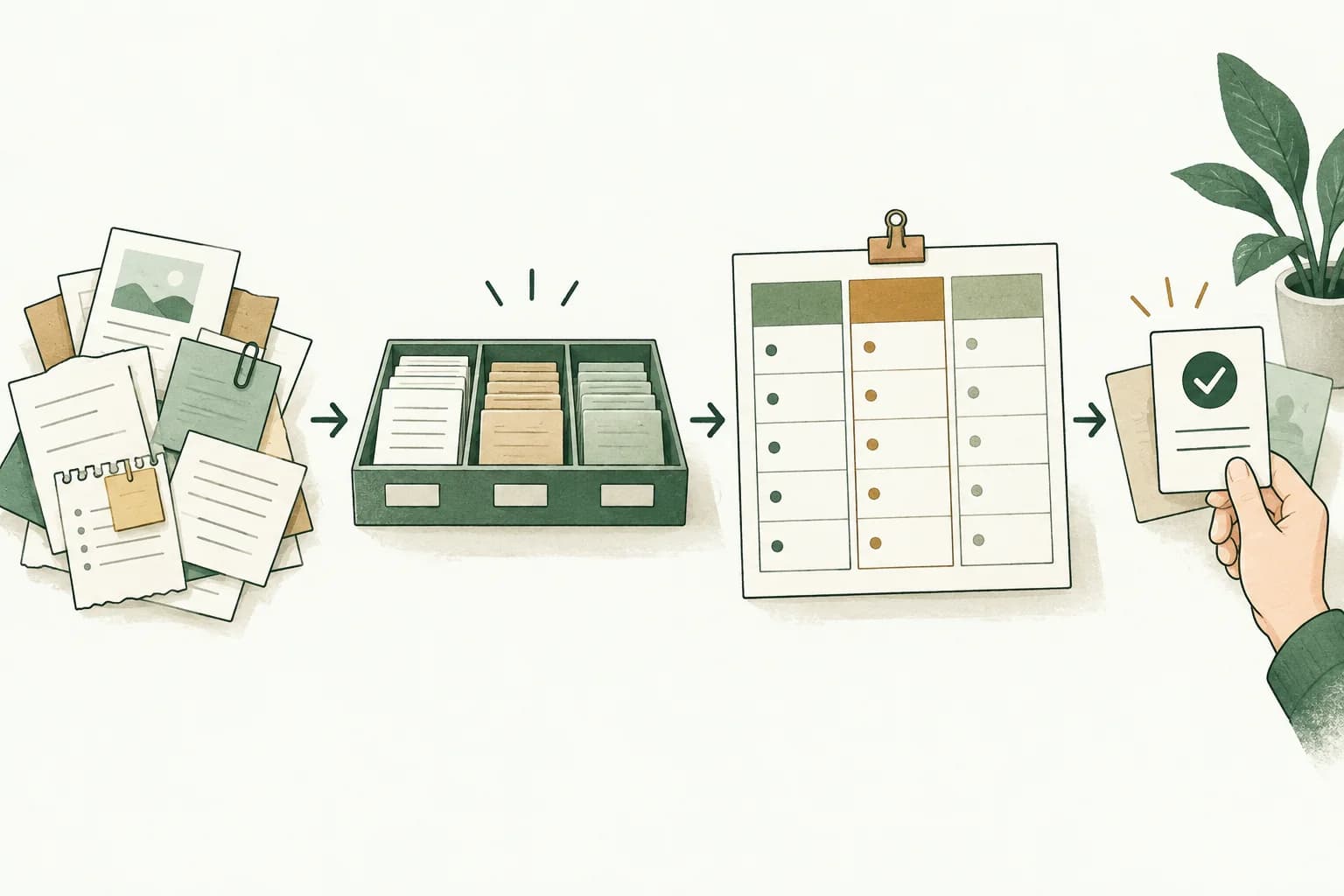
THE STARTING POINT
This article proposes an AI intake design for a solo or small-team service firm whose founder handles delivery, sales and quotes. Using Anthropic engineering material on fixed workflows and tool output as the lens, it argues that generating a price automatically is not the first move. Instead, split intake into extraction, gap questions, scope draft and founder confirmation, and return each step in a shape that lets the founder decide. This is a proposed A&A design, not a case study of increased win rates or margins; sourced facts, interpretations and a hypothetical example are kept distinct.
Vague inquiries and delayed replies happen together
A&A perspective
The intended reader is the founder of a service firm that already uses AI to deliver design or development work while handling sales. Inquiries arriving through the form typically say only "we want a new site" or "we want to talk about business efficiency". Requirements are usually missing, so before replying the founder asks back about scope, existing materials and how far AI integration should extend. The reply slides to the next day; the founder then consolidates the answers into a quote by hand.
A&A perspective
Even after the quote is drafted, exclusions keep accumulating. Prototype scope, revision count, integrations with existing systems, who supplies copy, post-launch operations – conditions settled in conversation do not always reach the next quote. Rather than starting with automatic price generation, our recommendation is to organize what intake handles first, so that the founder's judgment time is preserved.
Split intake into four steps using a fixed workflow
From the sources
Anthropic introduces the basic pattern of sequential model calls with the phrase "Prompt chaining decomposes a task into a sequence of steps".
A&A perspective
Applied to intake, this becomes four steps: extraction, gap questions, scope draft and founder confirmation. Extraction pulls target, purpose, desired date and budget signal from the message and any attachments. Gap questions phrase the fields that could not be extracted as questions to ask back. Scope draft tentatively lists what will be included and excluded in this quote. Confirmation is where the founder reads the draft and produces both a reply to the client and an internal case record.
A&A perspective
The same material argues for adding steps only when needed. Instead of aiming at automatic quote generation from day one, our recommendation is to let AI take on only the steps that consume the founder's time the most – usually gap questions and the scope draft. Price calculation stays as deterministic lookup against the existing rate table, and decisions on discounts and delivery dates stay with the founder.
Return intake results in a shape that moves the next decision
From the sources
On tool design, Anthropic writes that tools should "return only high signal information back to agents", distinguishing this from passing raw data in bulk.
A&A perspective
Applied to intake, the extraction step should return three things: fields that were extracted, fields that were not, and the source snippets in the original message. Preserving the pointer back to the original message lets the founder verify quickly, during confirmation, whether an item is genuinely absent. A confidence score alone does not move the next decision.
A&A perspective
The scope draft follows the same shape. Split it into included items, excluded items and items held for the next round, with references back to the extracted fields as the basis. The price column can be left blank on purpose. When a number is present, the confirmation conversation tends to move to pricing before scope; each firm can choose based on how it usually handles won and lost deals.
Hypothetical: one landing-page inquiry through the intake
Hypothetical example
The following is a hypothetical example. The form message reads only, "We want to build a landing page for a new service using AI, added to our existing site, ideally launched next month." Budget signal, whether copy is provided, the technical stack of the existing site, additional pages and what "using AI" actually means are all absent.
Hypothetical example
Extraction pulls target "add a landing page for a new service" and desired date "next month", and returns budget signal, copy provision, existing-site stack and AI scope as fields that could not be extracted. Gap questions phrase each as a single question, but the founder decides whether to send them together. Sending everything at once may lose some prospects, so the founder may choose to ask only about budget first, working backward from the scope draft.
Hypothetical example
The scope draft lists included items ("design and implementation of one landing page; client provides copy"), excluded items ("modifications to the existing site; post-launch operations; running AI-driven copy generation") and held items ("scope of AI integration"). During confirmation the founder adds notes such as "quote copywriting if the client has none" and "split AI integration into a separate consultation", and produces two outputs: a reply to the client and an internal case record. The founder writes the price by reading against the rate table.
Return post-quote scope changes to the same intake
A&A perspective
Additional requests from a client – "please also add one service page below the landing page" or "we want an AI-driven contact form as well" – often surface in phone calls or meetings. Answering with an on-the-spot verbal quote in that setting tends to leave exclusions unrecorded. Our recommendation is to route additional requests back into extraction and refresh the scope draft with the same included, excluded and held partition.
A&A perspective
For a returning client, the second and later intake outputs should list the scope confirmed in the first round alongside the additions. The design is not to rewrite the existing quote wholesale, but to treat the additions as an additional quote. What the founder decides is whether to quote only the addition or to reshape the breakdown of the existing quote; the AI's scope of responsibility does not change.
Separate the steps AI runs from those the founder decides
A&A perspective
Across the four steps, AI is used up to the first draft of extraction and scope. AI drafts the gap questions, but the founder finalizes the outgoing wording. Judgments about price and delivery dates, and exceptions that draw on prior conversations with existing clients, stay with the founder. This boundary exists so that a lost deal can be traced afterward to the step where the decision was made.
A&A perspective
Exceptions should not be defined as "do nothing"; each needs a defined route back to a person. A one-off large discount granted in the past, work that touches legal review, or inquiries that require integration with a third-party tool should drop into the held bucket during the scope draft, with a notification to the founder. Rather than having AI adjudicate exceptions, designing the granularity and routing of notifications tends to be more sustainable for a small team.
What this design does not show
A&A perspective
The mechanism described here is not a case study of increased win rates or higher margins. The two Anthropic sources referenced are not case studies of quote automation either; they are primary material on the composition of AI calls and the design of tools. Applying that overseas general design discussion to intake at a small Japanese service firm is presented as an A&A hypothesis.
A&A perspective
To assess cost-effectiveness after deployment, the founder needs before-and-after measurements: time from opening an inquiry to sending the reply; number of exclusions added after the quote was confirmed; and count and value of additional quotes generated by scope changes. This article does not provide those numbers. Treat this as a separate topic from the existing article on scoping AI implementations ("What to settle before an AI implementation quote"), focused on aligning intake inputs and outputs first.
Split intake into four steps, and return extraction results and the scope draft in a shape that moves the next decision. Rather than putting automatic price generation first, organize missing information and scope changes into a form the owner can handle. This is the design A&A proposes first when a small service firm brings AI into its quote workflow.
Sources & editorial note
Primary pages read for this article. Publication dates below belong to the sources; access dates record our research.
- Building effective agents
Anthropic · 2024-12-19
Accessed 2026-09-21 - Writing tools for agents
Anthropic · 2025-09-11
Accessed 2026-09-21
AI-assisted editorial production
A&A uses AI for research, writing, translation and editorial checks. Source facts, our analysis and hypothetical examples are labeled separately.
Editorial check: 2026-09-21