Give AI the prospect research first, not the email: test it on 10 companies
If AI is to take one part of your sales emails first, give it the research on the prospect company, not the writing.
Key points
- Research can be checked against sources
- AI gets facts, people pick hypotheses
- No reason, no email. Log why you skip
- Test 10 firms: research time and replies

Contents
Give AI the prospect research first, not the wording

A&A perspective
Sales email research here means reading a prospect's website and news before you write, to find a reason to contact them now.
A&A perspective
Automate & Augment (A&A), which writes this article, is a company that takes charge of AI adoption for small businesses as their outside lead. In our view, if a sales team hands one task to AI first, this research suits it better than writing the email.
A&A perspective
When the owner is still the company's best salesperson, more time goes into researching prospects than into polishing emails. Between opening the website, reading the news, and checking what the business actually does, the day ends after only a few companies.
A&A perspective
Having AI write only the email does little to cut that preparation, because the research still sits with the owner. And if AI writes without research, you get more emails that would fit any company once the name is swapped.
A&A perspective
Research suits AI for two reasons. First, most of it is collecting and arranging public information. Second, a person can check what was collected against its sources. Even if something is wrong, it can be stopped before anything is sent.
A&A perspective
There is an opposing view: the writing is what takes time, and letting AI write the emails and send more of them will bring more sales meetings.
From the sources
The case in the next section also says meeting bookings rose with AI-written emails.
A&A perspective
Even so, for the first task to hand to AI, A&A picks research, because people can easily check its results. The writing can be handed over later.
AI gathers facts and sources; people choose the hypothesis

A&A perspective
Even when AI does the research, what it collects ends at the facts and where they came from. The next step, a hypothesis about what the prospect may be struggling with and what to offer them, is chosen by a person.
From the sources
Anthropic, a company that develops AI, features a customer story on its own website about Apollo, which provides software for sales teams in North America.
From the sources
According to the story, Apollo's system has AI combine the data Apollo has built up with a prospect's recent news, events, and hiring activity. From that, it writes a message for each prospect that refers to what has happened recently.
From the sources
The story also describes matching a writer's style from samples of past emails that worked. Apollo's product lead says he believes in people working with AI rather than AI replacing people.
A&A perspective
What a small company can copy from this is adding the prospect's recent activity to the material for the email. A small company does not have a large in-house database like Apollo's. What it can use is public information: the prospect's website, news, and job pages.

From the sources
The story also reports that meeting bookings rose when AI-written emails were used. It names the comparison only as "reps using traditional email methods" and does not say over what period, or whether the conditions of those who used it and those who did not were matched.
A&A perspective
This is Anthropic, the company selling the AI, describing a customer on its own site. It is not evidence that a small company will get the same result.
A&A perspective
Collecting public information makes it easy to mix facts with hypotheses. "Their job page was updated last month" is a fact you can confirm by opening the page. "They are short-staffed and struggling" is a hypothesis drawn from it.
A&A perspective
If AI writes the two mixed together, the email looks well researched but presumes things about the prospect's situation.
A&A perspective
So split the roles. Have AI collect only the facts, the address (URL) of the page each came from, and the date it was checked. A person opens the sources, confirms the facts, and chooses a hypothesis that connects to your own service. The person with sales experience is the one who knows the prospect's industry.
| Column | Example | Filled by |
|---|---|---|
| Confirmed fact | Announced a new location | AI drafts, a person checks |
| Source and date checked | URL of the announcement and the date it was opened | AI |
| Possible problem | More handoffs of information between locations, perhaps | Person |
| First question to ask | Any work between locations they want to sort out | Person |
| Send or skip | Send, or the reason to skip | Person |
No reason to reach out, no email

A&A perspective
Even after the research, if you cannot write the reason for contacting a prospect in one line, do not send. Record why you skipped them, too.
Hypothetical example
For example, say you build a research sheet for each prospect with the five columns in the table above.
Hypothetical example
Even if the new location is confirmed, you do not write "your current system has a problem." What you can write goes only as far as a question: "Is there any work between your locations you would like to sort out?" Any offer is also limited to what connects directly to the prospect's recent change.
A&A perspective
If a prospect's columns cannot be filled, skip them instead of sending. If all that is left is "we can make you more efficient," which you could say to any company, you do not yet have a reason to contact them. Not filling blanks with guesses is how the sheet is meant to be used.
A&A perspective
Keeping the reasons for skipping on the sheet gradually shows which prospects your company can actually help. Stopping to check before sending also matches how the people who build AI systems think.
From the sources
Anthropic has written guidance for developers on building systems that use AI. It recommends starting with the simplest approach and only increasing complexity when needed.
From the sources
The guidance also describes splitting work into stages with checks between them. Among the conditions where AI agents, systems in which AI works through tasks on its own, are especially useful, it lists clear success criteria and the ability to build in human oversight.
A&A perspective
A&A sees the research sheet as close to this shape. It has three stages: collect, check, and decide whether to send. People handle the checking and the deciding.
Hypothetical example
At first, the sheet plus a chat AI such as ChatGPT is often enough. For example, ask: "List three recent announcements from this company, with the source URL and date." A person opens the returned URLs and checks them. A dedicated system can wait until a trial on 10 companies shows it is worth it.
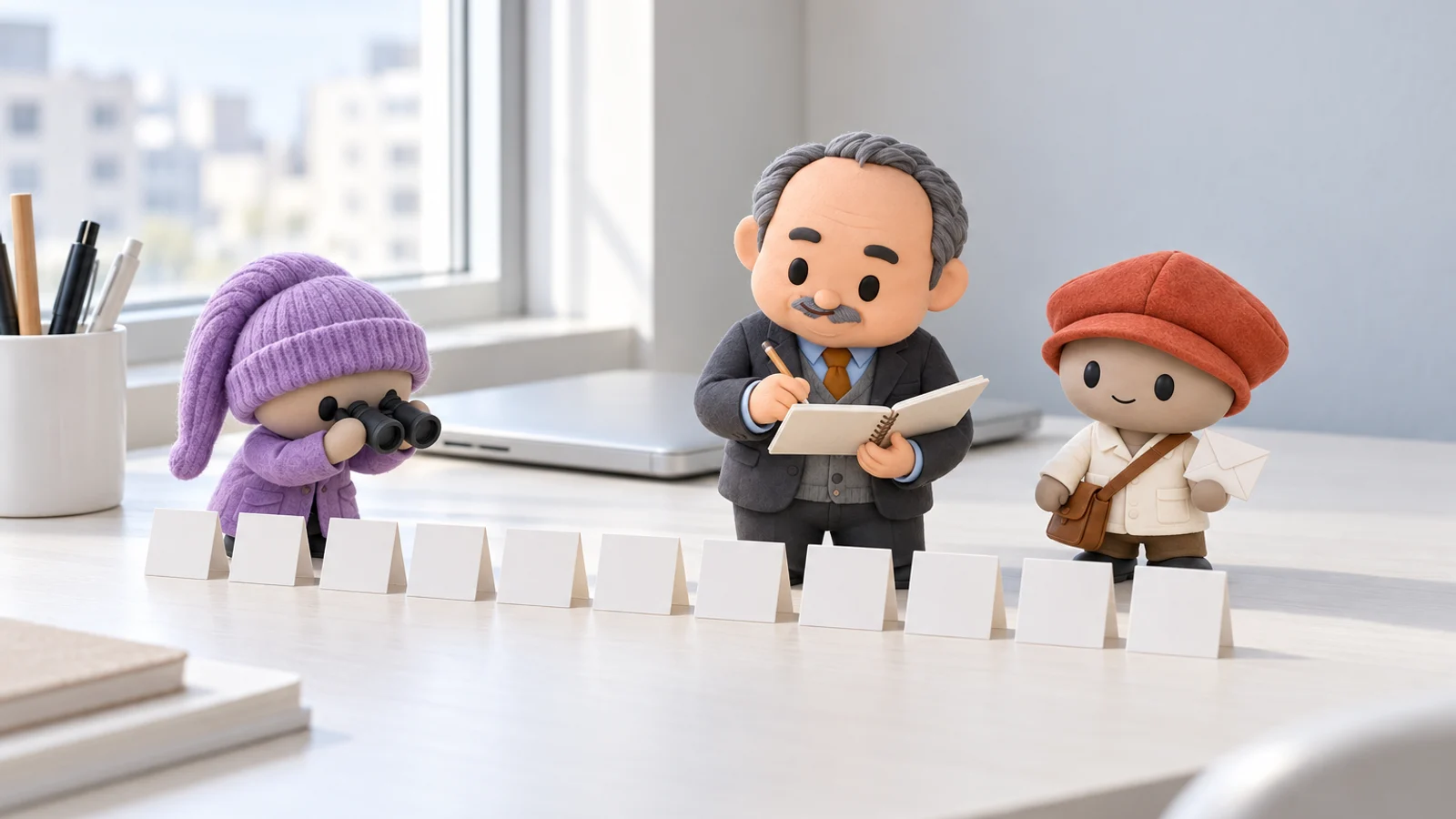
Test on 10 companies, then compare research time and what replies say

A&A perspective
Whether to keep giving research to AI is decided by a trial on 10 companies. The trial leaves on the sheet the prospects you could write a reason for and the ones you skipped. Then you look at two things: research time per company and what the replies actually say.
A&A perspective
Ten is not enough to prove an effect. It is a rule of thumb: few enough that you can look back over the sheet yourself and compare company by company.
A&A perspective
When comparing before and after AI, keep the size and industry of the companies you contact roughly the same. If you mix outreach to existing customers with outreach to new prospects, the difference becomes unreadable.
Hypothetical example
Say research used to take 30 minutes per company. If AI collects the facts and a person checks them, and that brings it to 15 minutes, a company contacting 40 prospects a month would free up 10 hours. These are made-up numbers. Replace them with how many companies you contact each month. When you measure for real, include the time spent checking and fixing.
A&A perspective
Freed-up time is not profit by itself. Hours saved multiplied by an hourly rate is not the same as the gross profit (sales minus purchases and outsourcing costs) that actually increased. Record separately whether the time moved delivery forward, went into proposals for important prospects, or simply gave you slack.
A&A perspective
Do not judge replies by count alone either. If replies rise but they are all poor-fit inquiries, the owner's effort has just moved elsewhere. Look at whether a reply led to a sales meeting and whether the prospect wrote back about their own company.
A&A perspective
When comparing with an outsourced sales agency, line things up by how many appointments led on to sales meetings, not by how many appointments were booked. Divide the monthly fee you pay the agency by the number of sales meetings that came through it, and you get the cost per sales meeting. On the AI side, divide research time and tool costs by the number of sales meetings in the same way.
A&A perspective
A&A recommends building the system that produces appointments inside your company, rather than buying appointments. The research sheet is the first part of that system. After looking at the time and the content of replies across 10 companies, decide whether to extend AI to drafting the email or keep the current setup.
Summary
A&A perspective
If you hand one sales task to AI first, make it research on the prospect company, not the wording.
A&A perspective
Have AI collect facts and sources; people choose the hypothesis and the offer.
A&A perspective
Do not send to prospects you cannot write a reason for, and record why you skipped them.
A&A perspective
Test on 10 companies and compare research time and the content of replies before expanding.
If you hand one sales task to AI first, make it research on the prospect company, not the wording. Have AI collect facts and sources, and let people choose the hypothesis and the offer. Do not send to prospects you cannot write a reason for, and record why you skipped them. After looking at the time and the content of replies across 10 companies, decide whether to extend AI to drafting the email or keep the current setup.
FAQ
Can AI also write the sales email itself?
Yes. But only after a person has checked the facts on the research sheet. The Apollo story also describes matching a writer's style from samples of past emails that worked. When you use samples, have a person check that terms or results meant for an earlier prospect have not slipped in.
Should we drop our sales agency and switch to AI?
There is no need to switch right away. Even with AI doing the research, deciding whether to send and holding sales meetings remain people's work. After seeing the results of the 10-company trial, redraw what you leave to the agency.
Will 10 companies show whether it works?
Not conclusively. Ten is a rule of thumb, few enough to compare one by one. If the time shrinks and the quality of replies does not drop, add more prospects and keep the same record.
Sources & editorial note
Primary pages read for this article. Publication dates below belong to the sources; access dates record our research.
- Apollo accelerates outbound sales at scale with Claude
Anthropic · undated case study page
Accessed 2026-10-21 - Building effective agents
Anthropic · 2024-12-19
Accessed 2026-10-21