Starting AI in small business: begin with one task you can judge yourself
Start with one task whose output you can judge yourself, so that your trial runs can tell you whether to keep it.
Key points
- Write your AI goal (e.g. fast proposals)
- Pick tasks you can judge, like proposals
- Count fixing time vs. how you work now
- Keep? Change? Drop? Judge by the goal

Contents
First, write your AI goal as one line

A&A perspective
By "the first task" we mean the first piece of work where AI drafts or organizes something and someone in the company checks the result before using it. Before choosing that task, write one line on what you want it to change. For example: "Cut the days between a sales meeting and sending the proposal."
From the sources
What to settle before using AI is also covered in public guidance. NIST, the US government's National Institute of Standards and Technology, publishes a framework for managing the risks of AI.
From the sources
That framework has an item for clearly defining the business value of using AI and the context in which it will be used. The framework is the 2023 version, and its public page says a revised version is in progress.
A&A perspective
Automate & Augment (A&A), which writes this blog, helps companies build, in-house, the system that produces their sales meetings.
A&A perspective
A&A's view is that for a small company, writing a one-line goal is enough to settle that value and context. Besides "cut the days until the proposal goes out," a line such as "tell existing customers about a new service sooner" works just as well.
A&A perspective
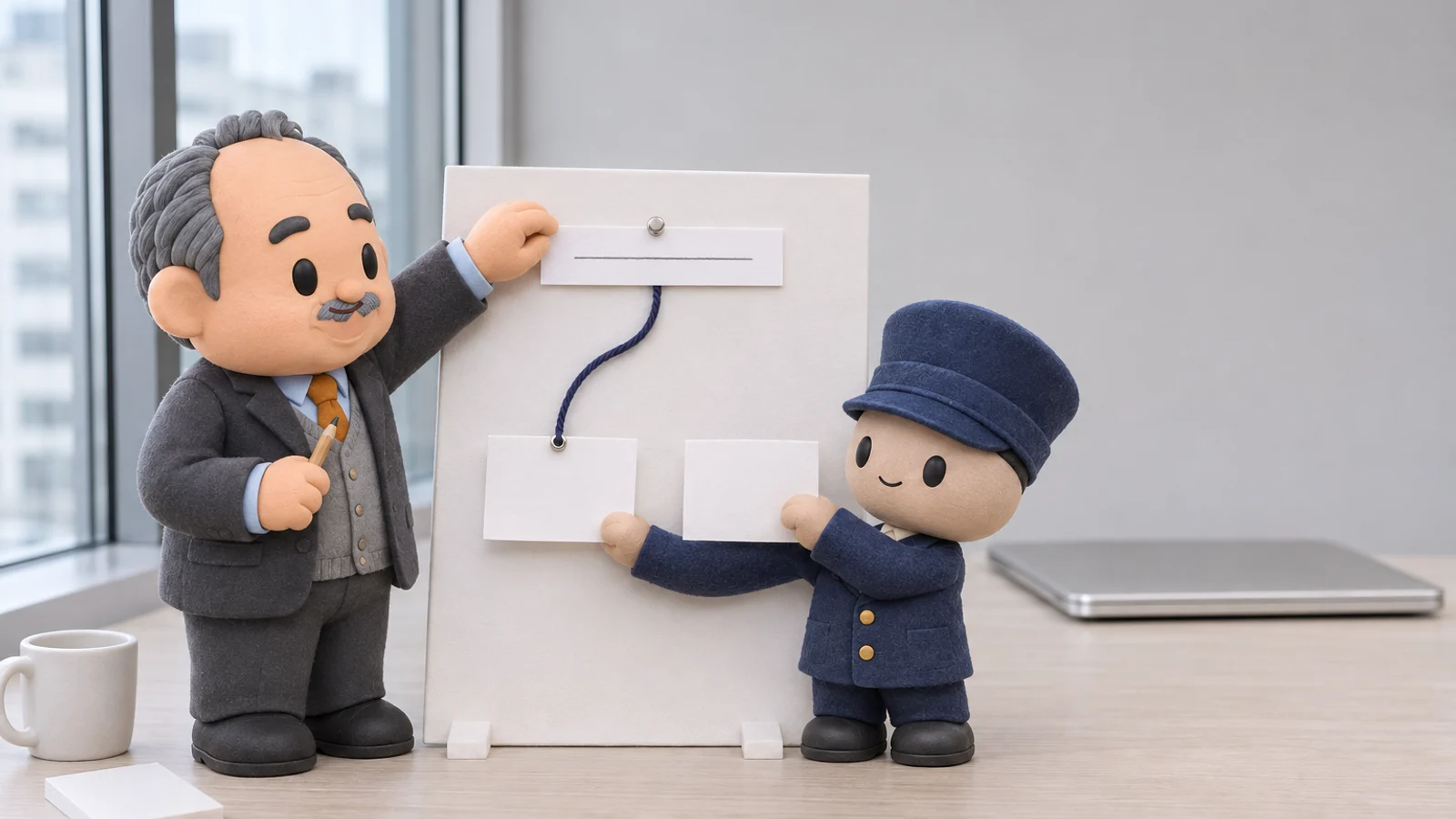
"Make things more efficient with AI," on the other hand, is not a one-line goal, because it does not say what should get better, or how. If you test without a line, even output that looks good leaves you unable to say what it improved.
A&A perspective
With a line, even the same idea of "having AI write the meeting minutes" splits into different jobs. Whether you want the minutes themselves or a faster proposal afterwards changes both the work you test and how you judge whether it worked.
A&A perspective
For a company that wants to grow through sales, a line about the work before and after sales meetings makes it easier, later on, to compare against what you spend on outsourced sales or on hiring.
Pick tasks whose results you can judge yourself

A&A perspective
Once you have the line, list the work connected to it and keep only the tasks whose results you can judge yourself.
From the sources
To build that list, a public catalog of common AI uses helps. It comes from Japan's Information-technology Promotion Agency (IPA), a government agency that promotes digitalization, and it lists patterns such as handling inquiries, writing and summarizing meeting minutes, and drafting and checking documents.
A&A perspective
But the catalog is raw material for candidates. In A&A's view, it does not tell you which one fits your company as the first task. So the criteria for narrowing the list are borrowed from the way AI builders think.
From the sources
In January 2026, Anthropic, a US company that develops AI, published a guide for developers on building tests that check how well an AI performs.
From the sources
It says a good test task is one where two experts in the field, judging independently, would reach the same pass or fail verdict. It also says it helps to prepare, for each task, a reference solution: an example of output that works.
A&A perspective
This is advice for people who build AI. Still, how results get judged matters just as much to people who use it. A&A applies the same idea to a small company choosing its first task.
A&A perspective
If the owner can say outright "this is usable" or "this needs fixing," the AI's output can be judged. If there is a past proposal that went well, it serves as the reference as it is.
A&A perspective
One view says to start with work AI handles well and rarely gets wrong, such as summarizing minutes. It is certainly easier to start. But if the work is far from your line, even a success gives you no reason to keep going.
Hypothetical example
For example, a company that wants to grow through sales might line up three candidates like this. It is a hypothetical example to show the thinking.
| Candidate task | Link to the one-line goal | Can you judge it? Is there a reference? |
|---|---|---|
| Draft a proposal from meeting notes | Directly cuts the days to a proposal | The owner can judge it in minutes. Past proposals exist |
| First reply to an inquiry | The entry point to a sales meeting | What to say varies from person to person. Example replies are scattered |
| Minutes of internal meetings | Can be far from the line | Easy to judge. There is a set format |
Compare several runs with how you work now, fixing time included

A&A perspective
Run the chosen task several times on the same meeting notes or documents, and compare it with how you do it now, counting the effort of fixing the AI's output.
From the sources
In the same guide, Anthropic writes that because AI output changes from run to run, it tries the same task several times. It also suggests building the first tests from the checks people already do by hand during development.
A&A perspective
A&A thinks the same idea works when a small company tries AI. If you decide on the strength of one run that went well, you may be looking at a lucky run.
Hypothetical example
Say you have AI draft the proposal after a sales meeting. For material, pick five past meeting notes, and make one of them deliberately incomplete. That shows whether the AI fills the gaps on its own. Real meeting notes are not always complete either.
Hypothetical example
The person judging is the owner, who normally writes the proposals. There are four things to compare.
Hypothetical example
Is all the information that is needed there?
Hypothetical example
Did it add conditions or amounts that are not in the notes?
Hypothetical example
Counting the time to fix it, is it faster than now?
Hypothetical example
Can the next person to read it use it as is?
Hypothetical example
Also time how long your current way takes on the same five notes. Without something to compare against, you cannot say it got faster.
A&A perspective
The time you compare is not only how long the AI takes to produce text. It also covers gathering material such as meeting notes, checking, and rewriting. If the AI is fast but fixing its output takes more effort than you spend today, that task is not right as your first one.
Decide by the one-line goal, not by hours saved

A&A perspective
Whether to continue after the trial depends not on how many hours were freed but on whether you got closer to the line you wrote first.
A&A perspective
Freed hours are not money by themselves. Only once you see whether those hours let you send proposals sooner, or go after new sales meetings, can you set them against the cost of outsourced sales or hiring.
Hypothetical example
Try some hypothetical numbers. Drafting a proposal takes 3 hours each, and there are 8 a month. If AI drafts bring that down to 1.5 hours each, checking and fixing included, 12 hours a month are freed. Then look at whether those 12 hours cut the days until the proposal goes out. This is a hypothetical example to show the calculation; real times vary with the work.
A&A perspective
When you compare with the cost of outsourced sales, do not set the monthly fees side by side either. Set the number of sales meetings the outsourcing brings in against the meetings added, or the days cut, by using AI.
A&A perspective
The decision splits three ways: keep, change, or drop. If you got closer to the line, keep going and widen the kinds of meeting notes you use for the same task. If the fixes are heavy, change things: check separately whether the material is thin, the request is vague, or the scope you handed over is too wide. If fixing effort does not drop and you get no closer to the line, drop it for now.
A&A perspective
Even if you drop it, you learn which work AI does not fit. That becomes material for choosing your next task.
A&A perspective
A&A helps companies build their own system that produces sales appointments, instead of buying appointments from outsourced sales. Getting one task around sales meetings running with AI is, in our view, the first part of that system.
Summary
A&A perspective
Write your AI goal (e.g. fast proposals)
A&A perspective
Pick tasks you can judge, like proposals
A&A perspective
Count fixing time vs. how you work now
A&A perspective
Keep? Change? Drop? Judge by the goal
Choose the first task from work that serves your one-line goal and whose results you can judge yourself. Run it several times on the same material and compare it with how you work now, fixing effort included, and the one-line goal tells you whether to keep, change, or drop it. Even a drop shows you which work AI does not fit, and that helps you choose the next task.
FAQ
I have only tried ChatGPT a little. Can I still choose the first task?
Yes. What you need for choosing is not knowledge of AI but knowing what a good result looks like in your own work.
Can I use documents with customer names and amounts from the start?
At first it is safer to choose a task you can test with names and amounts hidden. Decide whether to use real information after checking how the AI service handles what you enter, and what your company's rules say.
If the owner does the judging, won't that take even more of the owner's time?
The first few runs do take the owner's time. Once the criteria and a reference are in place, the checking can be handed to a staff member.
Sources & editorial note
Primary pages read for this article. Publication dates below belong to the sources; access dates record our research.
- AI RMF Core
NIST · 2023 (AI RMF 1.0; revision in progress)
Accessed 2026-10-21 - AIの利活用、AIによるDXの推進
IPA · 2023-12-20; updated 2026-09-11
Accessed 2026-10-21 - Demystifying evals for AI agents
Anthropic · 2026-01-09
Accessed 2026-10-21