AI translation quality check: test 10 product descriptions first
Try AI on 10 product descriptions, have a person check prices against the source, then decide whether to keep going.
Key points
- Test 10 descriptions with AI translation
- Check terms, meaning, buyer questions
- A person checks prices against source
- Continue or outsource: compare the costs

Contents
Test 10 descriptions with AI translation

A&A perspective
If you want AI to translate product descriptions for overseas buyers, try it on 10 of them before deciding whether to keep doing it in-house. Here, checking AI translation quality means a person reviewing the AI's translation before it is published.
Hypothetical example
Say a 20-person company that makes commercial kitchen equipment needs English product descriptions for overseas trading partners. Until now, it has either sent them to a translation agency or the owner has translated them.
Hypothetical example
The owner knows AI would be faster. But the fear that a unit price or lead time will come across with a different meaning means the owner ends up rereading every translation. It has become all or nothing: hand everything over, or reread everything.
A&A perspective
Automate & Augment (A&A), which writes this article, sees translating product descriptions as an easy first task to try with AI. The Japanese source already exists, the output can be checked against it, and the cost can be compared with what you pay an agency today.
A&A perspective
Ten is not a sample size that proves quality with numbers. It is enough to draw the line, on your own products, between what AI handles and what a person checks.
A&A perspective
Make sure the 10 include descriptions that state prices, minimum order quantities and lead times. If you test only descriptions without terms, you finish without checking the part you worry about most.
From the sources
Anthropic, the company that develops the AI Claude, has published an engineering article on building AI systems. It recommends starting with the simplest approach and adding complexity only when it is needed.
A&A perspective
A&A applies the same idea to a translation trial. For the first 10 descriptions, the AI you already use, such as ChatGPT, is enough. You can decide whether to subscribe to a dedicated translation service after you see the results.
Check terms, meaning, and the buyer's questions

A&A perspective
Check the AI translation on three points only: terms, meaning and the questions a buyer has before purchasing. Deciding in advance where to look finds what needs fixing faster than reading the whole text with no focus.
From the sources
One case comes from Lokalise, a company founded in Europe that runs a localization platform helping software teams deliver content in multiple languages. Anthropic published it as a customer story.
From the sources
At Lokalise, translators decide whether to accept, modify or reject each AI translation suggestion. The share of suggestions translators accepted, the acceptance rate, is 82.6%. The case also says more than 80% of the translations need no post-editing. It names giving the AI enough context as the condition for this.
A&A perspective
Context here means the background information you give the AI along with the text. For product descriptions, A&A thinks its core is a bilingual glossary: product names, model numbers, material names and so on, one line each in Japanese and English. Give it to the AI when translating, and when checking, see whether the translation follows it.
A&A perspective
When checking meaning, look at whether the wording of the original has changed. For example, if "can cook about 200 meals a day" becomes "cooks 200 meals" in English, an estimate reads like a guarantee.
A&A perspective
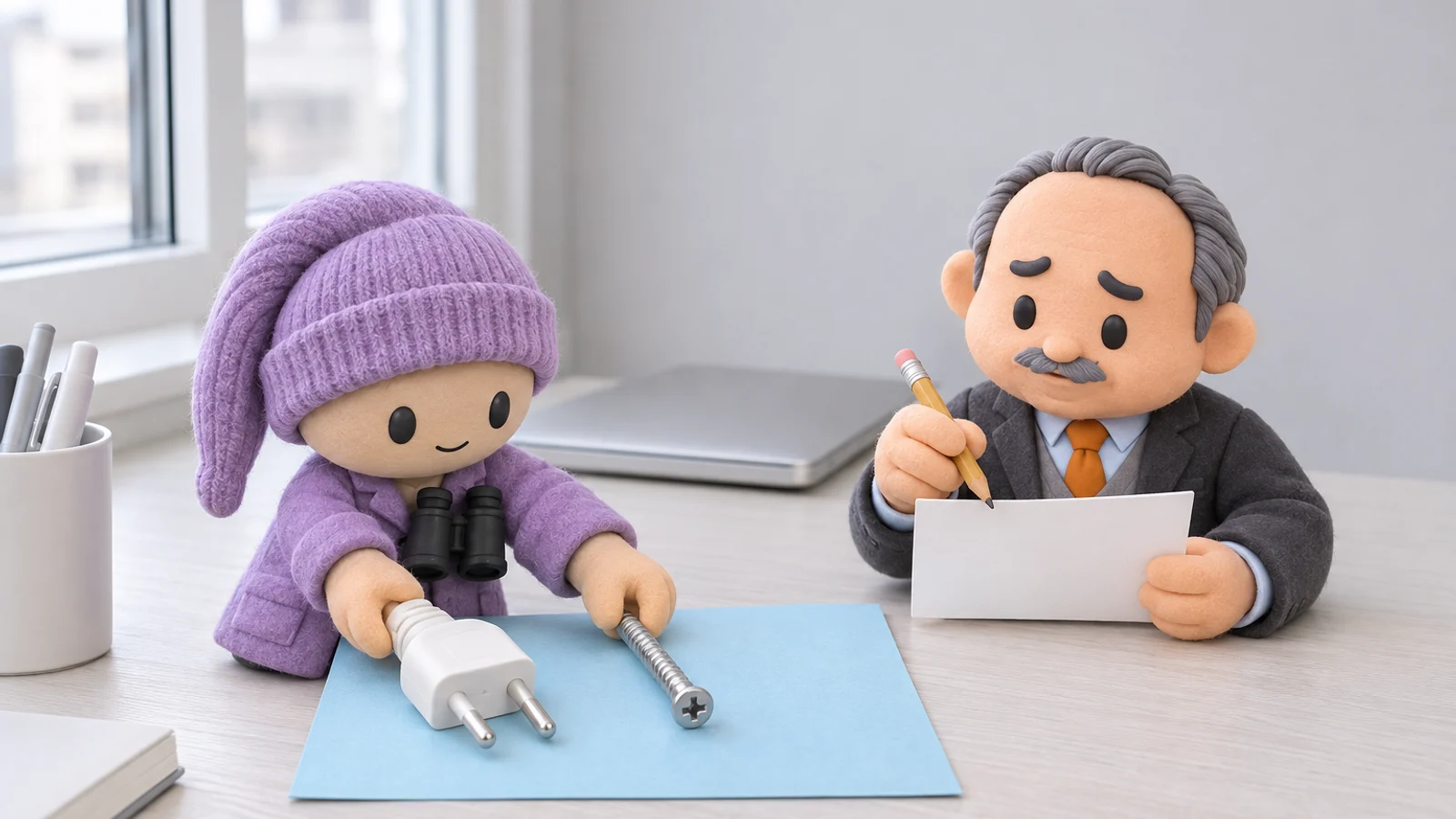
For the buyer's questions, have the AI read the translation as an overseas buyer and list what it would want to ask before buying, such as whether the voltage works locally or whether spare parts are available.
A&A perspective
If the description has no answer, the problem is not a translation error but something missing from the Japanese original. Retranslating will not fix it, so add it to the Japanese description.
From the sources
Anthropic's engineering article says that splitting the work between an AI that writes and an AI that reviews works well when there are clear evaluation criteria. One of its examples is literary translation.
A&A perspective
A&A sees terms, meaning and buyer questions as those "clear criteria" applied to product descriptions. With fixed criteria, the AI reviewer and the person look at the same things. You do not need a second AI: you can ask the same AI to review its translation afterwards.
A person checks prices against the source

A&A perspective
Do not leave trade terms such as price, quantity and lead time to the AI review. A person puts the source and the translation side by side and matches them one by one, because a mistake there costs far more than in any other sentence.
A&A perspective
A person checks three things against the source: price, quantity and lead time. Price means the unit price and whether tax or shipping is included. Quantity means the minimum order and units per box. Lead time means the days from order to shipment. Product features such as materials and use are left to the AI review and the three checks.
A&A perspective
A&A thinks an owner who is not good at English can still do this matching. Prices, quantities and days are written as numbers and units, so placing the source and translation side by side shows the differences.
A&A perspective
The best person for the matching is whoever set the term: the owner or a sales person for prices, someone in production for lead times. Even without reading the English, they can tell whether their own numbers are right.
Hypothetical example
Say the Japanese reads "ships in about 4 weeks." If the English becomes "delivered in 4 weeks," the shipping days disappear and it reads like a promise of the arrival date.
A&A perspective
Sometimes the Japanese itself is vague. If it is not settled whether the days count from the order date or the payment date, fix the Japanese before translating.
From the sources
Lokalise itself lists among its plans an evaluation that tells which translations need review and which are ready to publish immediately.
A&A perspective
A&A also looks at the other side of the 82.6% acceptance rate. Nearly 20% of suggestions were modified or rejected by a person. You cannot choose where that 20% will land, so decide from the start that a person always checks the parts where an error is costly.
Continue or outsource: compare the costs

A&A perspective
After the 10, compare the time a person spent fixing each description with what you pay for outsourcing now, and decide whether to continue. During the trial, keep a table of the fixing time and the kinds of fixes for each description.
A&A perspective
For each description, note which of terms, meaning or buyer questions needed a fix, which parts a person matched against the source, and how many minutes it took. With 10 rows, you also start to see where the AI translation tends to drift.
Hypothetical example
Suppose you pay a translation agency 10,000 yen per product description. In the trial, checking one description takes 30 minutes, and if the owner's time is valued at 5,000 yen an hour, that is 2,500 yen per description.
Hypothetical example
With these hypothetical numbers, the difference is 7,500 yen per description. If you write 8 descriptions a month, that comes to 60,000 yen a month. If AI costs a few thousand yen a month, the 5 hours spent building the glossary at the start pay back in the first month.
A&A perspective
All the numbers here are hypothetical. Recalculate with the times you measured on your own 10 descriptions and your actual outsourcing fees.
A&A perspective
A&A does not take Lokalise's numbers as a forecast for your company. They come from Lokalise's own localization work for software companies, and the same results may not hold for your product descriptions.
A&A perspective
The comparison leads to one of three outcomes. If checking takes clearly less than the outsourcing fee, go on to the next 10. If most fixes come from gaps in the Japanese source, fix the Japanese descriptions first.
A&A perspective
If no one can read the target language, or you only write a few descriptions a year, keep outsourcing. The trial can cost more effort than the outsourcing fee.
Summary
A&A perspective
Test AI translation on 10 product descriptions for overseas buyers, including ones with price terms.
A&A perspective
Check the AI translation on three points only: terms, meaning and buyer questions.
A&A perspective
For price, quantity and lead time, a person matches the source and the translation one by one.
A&A perspective
Decide whether to continue by comparing the time people spent fixing with what you pay for outsourcing now.
You do not have to choose between handing AI everything and rereading everything: a 10-description trial that settles what people check lets you start small in-house. What to decide next is whether to pick 10 descriptions, including ones with price terms, and run the trial, or to keep outsourcing because you write too few.
FAQ
Can we try this without anyone who reads English?
Yes. Prices, quantities and days are numbers and units, so you can match them against the source without reading English. For meaning, you can have AI translate the English back into Japanese and compare, but that is only a rough guide. Have someone who knows English check important sentences.
Should we subscribe to a dedicated translation service?
The AI you already use is enough for a 10-description trial. Once volume grows and you need a system that keeps the glossary and review records, choose using the approach in the separate article "Use existing tools or build a system of your own?"
What if the Japanese description changes after publishing?
Do not carry over the earlier check for the changed parts; check them again. Who takes on updating the translation is covered in "Who owns translation updates after publication: assigning ongoing update ownership."
Sources & editorial note
Primary pages read for this article. Publication dates below belong to the sources; access dates record our research.
- Lokalise improves translation quality with Claude
Anthropic · Publication date not stated
Accessed 2026-10-23 - Building effective agents
Anthropic · 2024-12-19
Accessed 2026-10-23